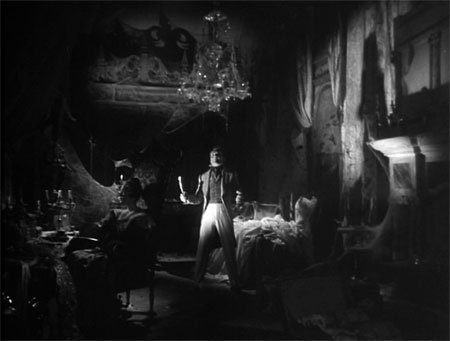
A part of this viewing list: Criterion Collection Spine #31: David Lean’s Great Expectations.
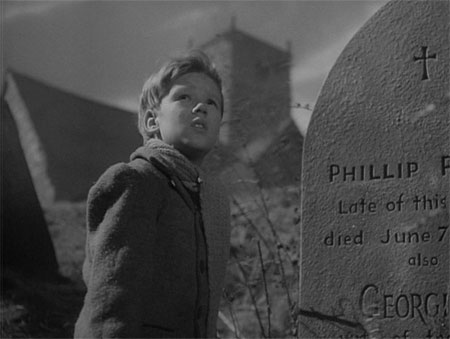
Upon seeing this version of Great Expectations, I’m fairly sure that I’ve seen it previously. As book-to-movie adaptations go, it suffers from the normal malaise of truncation, but not so much as other stories, since the verbose Dickens is involved. Alec Guinness has a supporting role, his first screen performance of any note, and is so bloody young that one’s mind is boggled. My generation was introduced to Sir Alec via Star Wars, near the end of his acting career, so it is doubly surprising for me to see him at the beginning of it. David Lean is a director with which I have some trouble discovering auteuristics, those tricks of the trade that become attributive of style to each great one. David Lean certainly is a great one, but his filmmaking strengths come not from his departures from conventional filmmaking, but his fidelity to them. His films are so good because they immerse you into the story, make you forget about the fiction of the silver screen so wholly that the full force of the narrative can be felt.
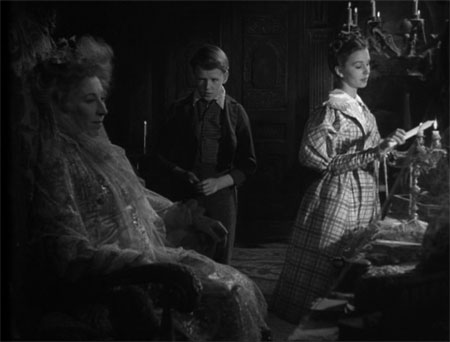
The narrative of Great Expectations rang with much more psychological terror and abuse than when I saw it at a less experienced age. The viciousness of Estella and the unwitting infatuation of Pip are like vinegar and baking soda, they can’t help but react together. The many strings and sub-plots weave such complexity that it is almost second nature to feel that audiences of the day were likely better able to appreciate that depth of filmmaking, which is a rare commodity coming out of Hollywood these days. It was probably rare then as well, but the post-modern ambiguous ending that would culminate a similar film today is no where to be found. In Dickens day, people wanted everything shipshape when they closed their book. Lean is his namesake and well-done at that, in this instance. He has excised enough material to make the film intelligible and not boring, while retaining just enough to guide the viewer to where he should linger.
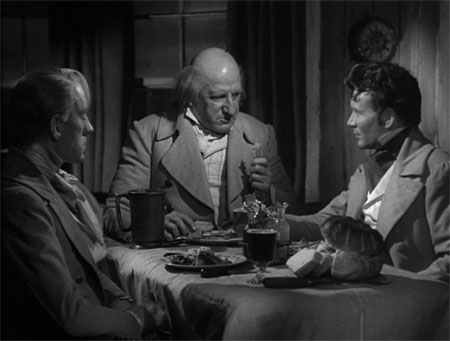
There are, of course, stumbles in this effort. Often the transitions from skin-crawly creepy scene to light-hearted indolence are jarring, and the motivations and history of a few characters are woefully but necessarily shunted aside. Some of the clichés of adaptation-cinema are present as well, although inconsistently. The open-book at the beginning, exactly quoted passages from the book, and voice-over narration are present, but inconsistent. The filmmaking is excellent however, and the approximation of candle-light is a testament to the excellence of the lighting crew Lean put together. It is possible to sense something like frustration on Lean’s part; it seems as if he knows he could get more pathos out of the same material if he wasn’t bound to the task of adapting a novel, something that is difficult at best, and impossible at worst. Like trying to film Don Quixote, for instance. I have three more adaptations to watch in the box set that came from the library, so it is time to get started on those, already.