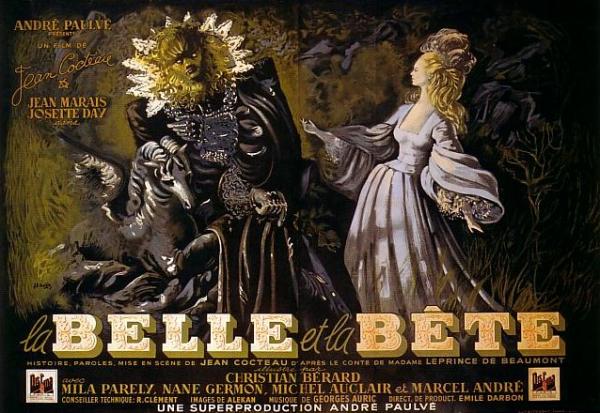
A part of this viewing list: Criterion Collection Spine #6: Jean Cocteau’s La Belle et la Bête.
At the present moment, a film that goes against average taste gets few bookings in France, and outside of some ambitious pictures undertaken to maintain prestige, production is almost at a standstill and the studios deserted. A poet engaged in film work must face another great difficulty: the immediate results demanded of a motion picture. A book can wait. A play that has flopped may be revived. A film must please at once, and we therefore have to devise ways to please and displease at the same time. There has never yet been an instance of something new not baffling the esthetes, the critics and the public, lazily accepting familiar formulas. The least challenge is apt to awaken a brutal and unpleasant response.
The more things change, the more they stay the same. Cocteau’s complaint about post war France is just as applicable to film culture today as it was then, and it also provides a good springboard to the role of the folk/fairy tale as a means of keeping things the same as they change.
Beauty and the Beast starts out with an eloquent plea from Cocteau to his adult audience. He encourages them to watch the film as if they were still children, basically a request to suspend their disbelief as they watch the film. I found this to be somewhat humorous, since Méliès [one of my favorite filmmakers] required a much larger suspension without the disclaimer. Of course, by the time Cocteau was doing his film thing, the industry had actually become an industry and audiences expected to see films instead of technological trickery. So the more things change the more they change. Cocteau
decided to make a film that would be a fairy tale, and when [he] chose the one that is the least fairy-like—which is to say the one that would need to make the least use of modern cinema techniques
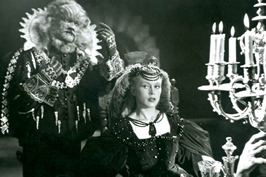
he essentially arrived at a position where ingenious use of theatrical ingenuity replaced most cinematic special effects. There are a few camera tricks, of course, but nothing that hadn’t been seen before. In fact, at the end, as the Belle et la Bête fly off into the sky, you can actually see the frame overlays thanks to the restored print. Where the set can be fully controlled, the cinematography is outstanding. The musical score got on my nerves, because it seemed a bit over the top. Mise en scene is where the film excels, as well as Jean Marais’s acting ability. He really nails the split personalities of a noble man wrestling with a beast’s nature.
 Now we can bring in the story of Beauty and the Beast itself. Like most traditional tales, it has a moral: you can’t judge a book by its cover; and like most traditional tales, it serves as a means of perpetuating basic cultural values. This is a curious basis for a story that Cocteau assumes originated in Scotland and is marketing to an American audience. Why do Beauty and the Beast then? Was it just an exercise for Cocteau? Well, maybe, but exercise is good for you, and Cocteau is promoting the childlike sense of wonder that is so close to my heart.
An argument could probably be made that La Belle et la Bête served an important role in redefining French culture after World War II, but I don’t think all things must be more than they are. I’m willing to take Cocteau’s intent as nothing more than a desire to entertain and amaze. Which, when done well, is a higher order of experience anyway.
• Criterion Essay by Francis Steegmuller
• Criterion Essay by Jean Cocteau
• The Criterion Contraption’s review.