A part of this viewing list: Criterion Collection Spine #2: Akira Kurosawa’s Shichinin no samurai.
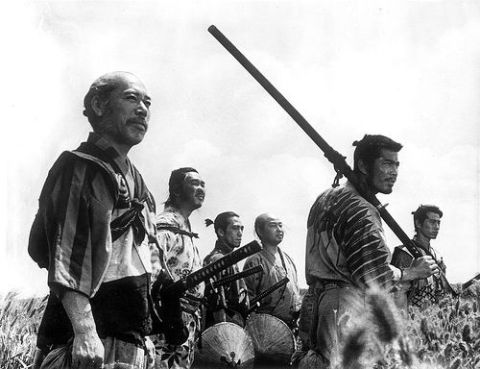
I’ve seen this film four times now, so it’s kind of hard to believe that I haven’t really written about it at all. This movie is so very very good and very very entertaining that people who absolutely hate foreign films should still give it a try. While Kambei [Takashi Shimura, who I’ve seen previously in Inagaki’s version of The 47 Ronin] is the leader of the rat-tag ronin, the show is always stolen by Toshiro Mifune’s character: Kikuchiyo.
It should be pretty obvious why this occurs. Kikuchiyo is the only character in the film that is complicated. Katsuhiro is basically just a horny young man, Kambei [who dearly misses his chonmage] is an old war-dog, Manzo is just worried about his daughter, et cetera. Kikuchiyo however, well, he has unwittingly made himself into an existential hero by his inability to reconcile his past and his ambition.
So he’s an ex-farmer whose parents were killed by bandits, and somehow he grew up, forgot his own name, got his hands on a samurai lineage scroll [sort of a patent of nobility in a sense, I think] got himself a bigass sword and then tries continually to become the very thing he hates, a samurai. Kikuchiyo basically hates the world, but his personality is such that, instead of being all depressed about it [although he does have manic-depressive tendencies] he fights and fights and fights. His posturing and swagger around the samurai he is trying to impress do little to his credit. His fierce individuality is a liability to the defense of the village. Yet.
When he forgets himself we see his considerable strengths. He is intuitively intelligent despite having no education, valiant, and an excellent source of motivation. As an outcast, he acts as an intermediary between the farmers and the samurai, and his compassion for the farmers is obvious, despite his disgust at the life they lead.
His death is necessary and inevitable. If he survived, Kurosawa’s message would be overshadowed by the personality of Kikuchiyo. In death, the path is cleared for Kambei [still sans topknot] to reflect on the ultimate tragedy of bushido. A samurai can live with honor, but always fails in his goals. Kikuchiyo’s death becomes a victory then, for it was on his own terms, completely personal, not bound by any code or debt.
• David Ehrenstein’s Criterion essay.
• Some artist renderings of shots from the film.
• The Criterion Contraption’s review.