A part of this viewing list: Criterion Collection Spine #10: Nicholas Roeg’s Walkabout.
It is probably just me, but it seems like the 1970s were filled with films featuring nubile and naked young Australian women in Edenic settings. Walkabout is one of those films. I could put a full frontal picture of Jenny Agutter’s character here, but instead here is a picture of her father committing suicide.

While the nudity is interesting from a certain point of view [and we’ll get back to that, oh yes we will] the film isn’t really as shallow as it has sometimes been billed. [Check out the exploitative playbills which use black-man-fucking-a-white-girl-jungle-primitivism to titillate, as an example.]
Essentially, the tension of the movie revolves around growth into a society, learning to adopt the roles and rules particular to each one. Although the young Aborigine man and the young Aussie girl are as far apart socially as they can be, they are both progressing through their own culture-specific liminal phase. Successful completion indicates adulthood. We’ll get back to that as well.
The plot: Daddy takes his kids out on Holiday to the desert, tries to kill them, and then kills himself. The Nubile Young Middle-class White Woman in her Short-skirted Schoolgirl outfit takes her Little Brother into the Desert. They almost die from Exposure until they meet the Nearly-Naked Young Black Man [an interesting paper could be written about the significance of the order of adjectives used to modify human-referent nouns] who is Wise in the Ways of Nature and agrees to Take Them Home. Essentially it is merely a modification of the basic narrative structure: Two men set across a valley, have many adventures, and return home safely.
There are two main things that I should write about. The first is the culture gap between the Aborigine and the girl. To do this, I will start with the little boy, who makes a relatively effective bridge between the two, he can communicate with either of them and also serves to indicate that the liminal phase is something that is only entered at a certain age and under certain conditions. The girl is by turns admirable and annoying. Despite her ignorance of the outback, she is determined to save her brother and herself, and is well prepared to keep them motivated. Once the black boy shows up, she becomes completely useless, expecting him to do all the work. This probably stems both from a racial disdain and a culturally instilled dependence on a strong male figure. She is constantly washing her clothes and trying to make herself remain as pretty as possible, as if she weren’t in the middle of the fecking wilderness. This probably helps keep her spirits up, but it definitely shows how alien she is in her surroundings.
The Aborigine, on the other hand, is on walkabout: his six month journey to manhood, where he must use his skill to survive. He is extremely well-suited to his environment, so well-prepared in fact, that he can support two free-loading white folks and not even slow down. He would be a man already, if only he would acknowledge it.
The second issue concerns the rite of passage itself. The Aborigine feels that he needs to have sex in order to truly be a man and complete his liminal phase. The girl sorta wants to pork him, but doesn’t because she’s a Proper White Girl and he’s a Primitive Black Man. Her repression and passivity seem to be part-and-parcel with the Western rite of passage. What rite of passage, you say? Exactly. For us it is such a drawn out affair and virtually stripped of ritual significance. When are you an adult? Oh, when you get your license, or when you can vote, or when you can drink. There is no defined time and affirmation of adulthood.
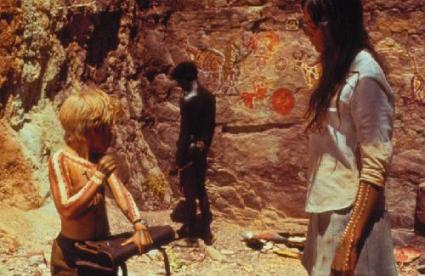
This is where the film flexes its muscles. The father committed suicide and attempted to kill his own children because he was adult by age, but not maturity. His society did not adequately prepare him for its demands or affirm his position within it. Bereft of meaning and lacking vested manhood, suicide is his escape. The Aborigine boy committs suicide because, after weeks of proving his skill at providing a living for the girl and her brother, abilities that would have earned him the respect and love of just about any Aborigine girl, his last, beautiful and overt sexual advances are callously rejected by the girl. His suicide is both the result of heartbreak and a complete and final disdain of everything he [and his culture] holds dear.
The girl, years later, living in the same apartment she grew up in and fully a part of the culture she yearned for while lost in the outback, now wishes she had remained with the Aborigine boy.
So the movie seems to be a pretty scathing critique of Western cultural callousness. [And I haven’t even mentioned a few rather strange interludes involving weather balloons, plaster kangaroos, and “big game” hunting] It doesn’t offer the Aborigine lifestyle as a better choice, but it does seem to insinuate that even a life where the next meal is a thing of uncertainty is better than the rage or hopelessness engendered by a life without knowing one’s place in the world.
• Criterion Essay by Roger Ebert
• The Criterion Contraption’s review.