A part of this viewing list: Criterion Collection Spine #326: Whit Stillman’s Metropolitan.
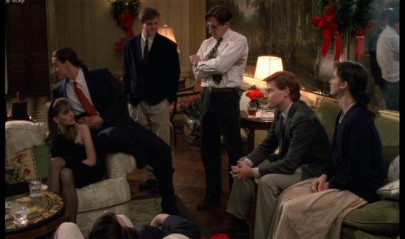
Metropolitan is a movie about the Urban Haute Bourgeoisie, debutantes and their escorts, people who read literary criticism but not the actual books, and kids who obsessively worry about their own downfall, debate theoretical political systems and don’t know how to drive a car. I would detest having even the slightest contact with these people, who are essentially all talk and no follow-through. Yet I enjoyed Metropolitan and I’m glad it made me go mental.
Metropolitan is a movie about class, and though the only class present is the upper-class, the “UC” as the characters so smarmily refer to it, this focused approach effectively made me examine my own class situation in a new light. Luc Sante’s essay, linked at the end of this post, says that America pretends that class doesn’t exist. I think this is close but not quite. I think many people who aren’t consider themselves to be middle class. This makes sense, since middle class can cover ground from someone like me who makes less than $30k a year to someone like a surgeon, who might make twenty times as much. We’re still people make ends meet by working for our pay. In Metropolitan, discussion centers not on the necessity of work to make ends meet, but on the choices of profession that should maintain or strengthen their status as UHB. They don’t need to work, but they need something to fill the time.
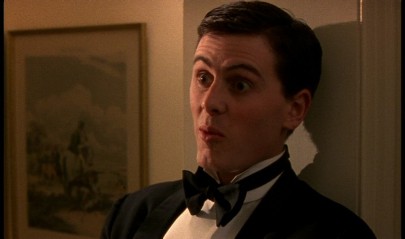
The character that lets us [middle-classers] enter in to this world is an ex-trust fund kid who, after his parents’ divorce, has become one of the middle class. In this movie, one is never poor, only “financially limited.” But Tom’s financial inadequacy is blatant. He has a rented tuxedo and can’t afford a greatcoat to keep off the chill of Manhattan winter. His parent’s are also divorced, another middle class distinction. Yet he went to prep school and has the right pedigree in all other aspects. In fact, just having a pedigree helps him enormously. Some folks think he is a fake, but as the film develops we find that, to some extent, each character is playing the role of the UHB at the price of his or her own soul, and they’re all fakes. Most importantly we learn that Nick, who seems to be the ultimate UHB, is closer to Tom than we realize.
This triggered all kinds of thought processses. I realized that I had been watching the economically derived cultural aspects of the upper class, which functions like any other cultural base, with its own taboos, rites of passage and etiquette. This in turn made me examine the cultural aspects that have resulted from my own middle class existence. This is the main strength of the film, by showing us another class trying to figure itself out, we in turn examine our own status and role. It almost seems to indicate that culture does more to stifle true expressions of self than ease interaction with others. Perhaps this is merely an effect of the examination of the strictly controlled exclusivity of the UHB, but I found myself relating to almost every male character in the film. It would be interesting to watch it with a woman to see if she feels the same in regard to the debs.
This film would be a good tag team with Spike Lee’s Bamboozled for an examination on how class and ethnicity are knotted.
Tom also serves as a reflection of the movie itself, which has be appear high class while being “financially limited.” I forgot to mention that.