A part of this viewing list: Criterion Collection Spine #33: Robert Flaherty’s Nanook of the North.
This is the third time now that I’ve seen Nanook of the North. I’m currently rewatching films I’ve already seen but not reviewed that are on the Criterion list. Despite the fact that Nanook of the North is filled with more inaccuracies and staged scenes than actual ethnography, it is important to realize that though much of its criticism is accurate, it isn’t all justified.
Flaherty was blazing trail for feature length non-fiction filmmaking, as well as location shooting in harsh environments. The camera he used was so large that a non-authentic three-walled igloo had to be constructed to allow enough light and space inside for filming to take place. He used this equipment in the Arctic, on ice fields and in blizzards and hauling it hundreds of miles. And while actualities were common fare at nickel odeons, constructing a non-fiction narrative of this sort had never been done before.
This is a situation in which criticism should not be personal. In hindsight, taking in the legacy that Flaherty created with documentary cinema, it is easy to rip Nanook of the North to shreds as more story than document, but aim would be better taken at documentaries which are arranged in the style of Nanook and continue to make the same mistakes and falsifications, often deliberately.[Michael Moore, I’m looking at you.] In fact, I would argue that Flaherty made no mistakes in the filming of Nanook apart from being careless enough to accidentally burn the negatives from his previous attempts at making it.
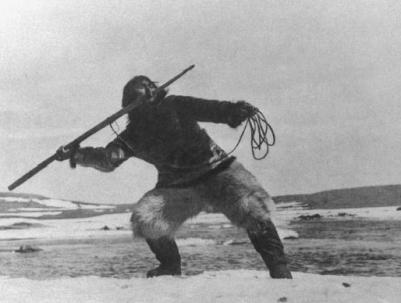
From an ethnographer’s standpoint, Flaherty’s insistence that the Inuit use methods that were already becoming used less and less often was inspired. The prevalence of firearms, Western building materials and motorized watercraft was on the increase, and likely within another generation it would have been impossible to make a film like Nanook of the North. So Flaherty was unknowingly creating salvage ethnography that has been equally important to anthropology as to cinema. It is no coincidence that I watched this film once in a film class and once for an anthropology class.
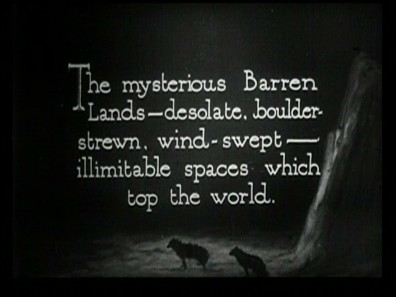
It is possible to read the film as a meta-document about spectatorship in the early 20th century as well. Flaherty was clever enough to realize that he must craft a film that his audience would enjoy so we end up with patronizing and romantic intertitles and oscillating shots of the Inuit as skilled and simple [Nanook and the gramophone being a prime example of the latter] but always as savages. Flaherty’s presence as a character within the film is minimal, unlike in Hoop Dreams [another Criterion title] where the director acts as a participant-observer.
Ultimately, I think it is important to recognize the faults in a film like Nanook of the North while not holding it against the filmmaker. This film is truly a landmark of early cinema, so it is no surprise that its form continues to be copied even to this day. Mistakes and all, and even by those who should know better.
• Watch the entire film at Google Video.
• How I Filmed Nanook of the North by Robert Flaherty.
• Criterion Essay by Dean W. Duncan.
• Roger Ebert essay.
• DVD Outsider Review.
• Misrepresentation of reality in Nanook of the North [with a tiny video clip] Full project on the film here.
• Gerhard Lampe’s academic analysis of Flaherty’s style.
• The Criterion Contraption’s review.