A part of this viewing list: Criterion Collection Spine #23: Paul Verhoeven’s RoboCop.
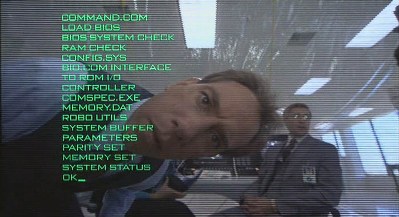
This is a good time to explore the Criterion Collection’s mission statement, since I know plenty of people think that having RoboCop on a list with The 400 Blows and 8½ is an abomination.
The Criterion Collection, a continuing series of important classic and contemporary films, is dedicated to gathering the greatest films from around the world and publishing them in editions that offer the highest technical quality and award-winning, original supplements.
RoboCop is the kind of film on which an enterprising and lazy film student could base an entire thesis. It is a post-modern masterpiece, in both lit-crit and cult-crit usages of the term. While films like The Terminator and The Matrix are also excellent post-modern films, they lack a certain cultural applicability that is the main motive force in Verhoeven’s image of the future. To call RoboCop a comedy or satire is to do it a great disservice. It is often barkingly funny, but the pervading brutality, callousness and cynicism is not present for its own sake but to flesh out an idea and warning about Verhoeven’s prediction of cultural evolution in the late 1980s. The fact that RoboCop is more and more often billed as a comedy does more to strengthen the prescience of the film than anything else. We laugh at RoboCop because we are continually becoming closer to the future it predicts. We laugh because it is correct, even though we don’t want to believe it.
RoboCop, therefore, becomes the poster child of post-modern man. And there is nothing funny about him. While gay gang-member drug dealers blow apart Detroit with huge guns held crotch-high spurting fire [No, I am not kidding], RoboCop is driven by his prime directives to bring justice to all and sundry but for a select few. He is a man imprisoned within circuitry, who can feel his family although he cannot remember them. With a subjectivity so fractured and controlled by corporate and political interests there is little cause for RoboCop to accept the name of the dead man he is [Are all cops named Murphy?] or to accept anything at all.
RoboCop is far too sympathetic a character to be funny. Despite all of the strictures placed upon him, he strives to be as autonomous as possible, to live up to obsolete standards in a cutting-edge environment with ADD newscasts NUKEM board games; he ultimately triumphs because his prison is also his weapon. So if that isn’t reason enough to include RoboCop in the Criterion list, nothing I can say will change your mind.
I can’t end this review without mentioning the stop-motion animation debt that the film owes to Ray Harryhausen. I love that man, and were it not for him, the ED-209 and the 6000 SUX commercial, integral to the cultural aroma of the film, would have not been nearly as effective.

• Criterion Essay by Carrie Rickey
• YouTube clip of RoboCop’s introduction, one of cinema’s great reveals.
• The RoboCop Archive
• The Criterion Contraption’s review.