A part of this viewing list: Criterion Collection Spine #332: Luis Buñuel’s Viridiana.
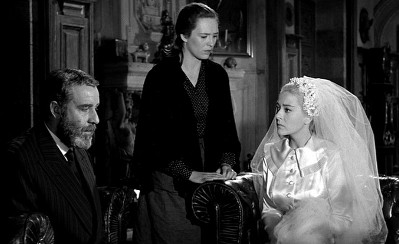
Viridian comes from the Latin viridis, meaning green, but color has little to do with Buñuel’s Viridiana. He took the name from the life of a St. Viridiana [Feb 1st], but that is tangential to the action of the film. It is almost easier to talk about what this film isn’t than about what it is, an influence which stems, I think, from Buñuel’s associations with surrealism and his own understatedly interesting personality. I’ve seen Un chien andalou and Las Hurdes, but this is the first of Buñuel’s work that I’ve seen with an obvious narrative structure. The film itself is above average, but it becomes more interesting when placed within the context of its production and distribution.
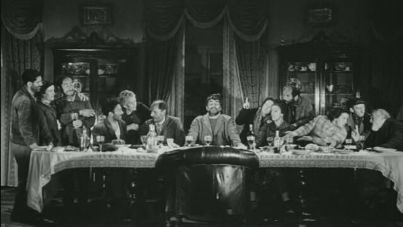
This won the Palme d’Or at Cannes and was then promptly denounced by the Vatican, subsequently banned in Spain [after being approved by the Franco’s fascist censors] and all kinds of other hoopla. This is a film where many things are fetishized, a little girl’s legs, the novice Viridiana’s legs, women’s clothing; and other things are merely day to day tongue-in-cheek comedic misappropriations, jump-rope, cloth, music and art. Above all, Viridiana is a comedy in the oldest sense of the word. The main characters never practice what they preach, are blind to their own faults, and seem driven more by instinct than will or reason. The blasphemous aspects of the film seem to me to be less blasphemous and rather more concerned with pointing out structural inadequacies in the relationship between real life and spiritual life.
Buñuel appears to be making pointed commentaries about the land he returned to after a 20 year exile and the world that could creat fascist Spain. I don’t think the commentaries are intentional, because the film is not preachy, but there are unavoidable reflections of Buñuel’s personal worldview echoing throughout. His distaste for modes of control is quite evident in Viridiana. Viridiana herself tries to control and direct the welfare of the beggars that she takes in, but does more to restrict than allow the beggars room to live. Similarly Don Jaime and Don Jorge’s attempts to control the women in their lives show the emptiness of the men’s lives and a possible weakness in the culture of Spain at the time [that’s just a guess]. The control critique is most obvious in the religious aspects, and in the end it seems that the message is: Accept and revel in the messiness of life instead of trying to control it.
Almost an anarchic message and certainly a surrealist one.
• Criterion Essay by Michael Wood
• Objects of Desire: Conversations with Luis Buñuel [If you’re willing to drop 6 bucks to read this interview with Buñuel about Viridiana and other films]
• Senses of Cinema article on Luis Buñuel and Viridiana