A part of this viewing list: Criterion Collection Spine #19: Samuel Fuller’s Shock Corridor.
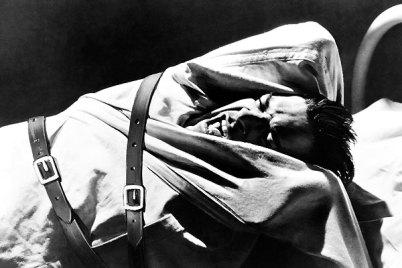
It was nice seeing this film again. Samuel Fuller has that peculiar position that only seems possible in the world of film; a master of cinema, but also a producer of schlock. Shock Corridor is a perfect example of this sort of doublethink. It most certainly is a piece of exploitation cinema, meant to bring people to the theater through its overblown and seedy portrayal of the mentally ill, but it also supplies the spectator with thorny political questions in a distinctive, masterful and lurid style.
The actors are no-names and the acting is blunt. So is the editing. So is the dialogue. Fuller has no patience with flair in this film. Although there are parts that seem quite stylistic, they were not done for stylistic reasons. Each choice is made for practical utilitarian efficacy and it is from this focus that the style derives. This is very different from The Sword of Doom, where madness is subservient to its portrayal. In Shock Corridor, madness points to its own causes as, in brief moments of lucidity, the patients explain and inherently criticize the social stresses which drove them mad.
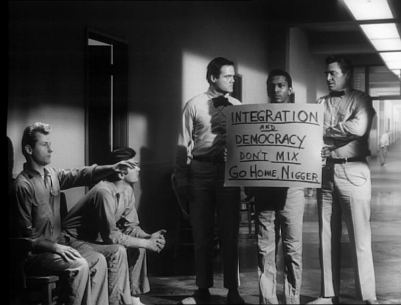
Fuller uses these moments to make his great political points. One patient, a sort of Manchurian candidate traitor who thinks he is a Confederate general explains that Communism offered him what his own upbringing never could, education and open-mindedness, at the cost of his loyalty to his country. An infantile ex-Manhattan project scientist preaches of the evils of Cold War mentality arms-racing, and most disturbingly the first black student to attend a white university tells how the racism of the South drove him mad, ultimately convincing him that he is the founder of the Ku Klux Klan and a white supremacist. [See the YouTube clip linked at the end.]
In another vein, Johnny the reporter, who has infiltrated the asylum in order to determine which of the three characters above can identify a murderer, is slowly driven mad by his proximity to the patients and the treatments adminstered to him by the staff. The destruction of his personality due to an excess of ambition becomes the basis by which we can empathize with the plights of the other patients. The scene with the nymphos [Resulting in one of the best VO narration lines ever: “Nymphos!!”] is exploitation cinema at its best, but is a necessary step for Johnny’s road to madness.
There are aspects of noir to this film that can be examined in comparison to Fuller’s Pickup on South Street, but since that is also a Criterion film, I’ll do that then. I’ll simply say now, that a reporter protagonist and his stripper girlfriend are the archetypal seedy characters for noir.
This is another film where the cinematography is outstanding. Stanley Cortez’s camera movements and framing invite the viewer into each patient’s subjectivity. These sequences are the films most blunt and most effective. The viewer is startled by abrupt switches to color stock footage when the patients hallucinate and the scene with Paliacci’s singing is jaw-dropping in terms of both cinematography and post-production. [See the YouTube clip linked at the end.]
For those who find grace and style to be inseparable and any art that is not “high” to be no art at all, this film will seem like so much trash. For the casual viewer the film will offer entertainment but its angry tone and suggestion that madness is the only escape from a world gone mad will not resonate. The result is a film that demands an open mind and broad taste for true appreciation of all its aspects. Just like everything else ever, really.
• Criterion Essay by Tim Hunter
• Culture Court essay by Rick McGrath.
• The Guardian review.
• Many stills and captions from the film.
• YouTube clip featuring the black white supremacist.
• YouTube clip of one of Johnny’s dream sequences featuring Paliacci.
• The Criterion Contraption’s review.