A part of this viewing list: Criterion Collection Spine #14: Hiroshi Inagaki’s Samurai I: Miyamoto Musashi.
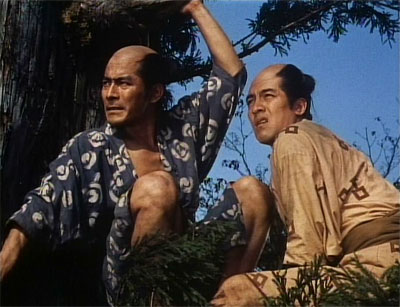
Miyamoto Musashi is the first installment of Hiroshi Inagaki’s Samurai Trilogy, an action-packed series of films that follows the life of Japan’s greatest warrior as he grows into his legend. This initial film shows a very different Musashi from the one most people are familiar with; when he was known simply as Takezo, and was a hunted and feared bandit. Toshiro Mifune, who plays Musashi, is perfect for the role; one might argue that thoughts about Musashi are at the core of most of his samurai performances. Yet, in this first film we see little of the nuance that Mifune is capable of, instead we are immersed in the unfettered and unfocused intensity that is his other strength.
The cinematography is careful to remove most of Takezo’s humanity, often showing him in shadow, obscured by brush, or pursued by picket lines of searchers, like a hunted boar. As he gives himself up wholly to this wildness he becomes darkness personified, and years later as he emerges as a focused and strong samurai, there is a parallel with his emergence into light. Every aspect of Musashi’s character growth is carefully managed and packaged in such a way that, although we are rarely privy to his actual thoughts, we understand his motivations as if they were our own.
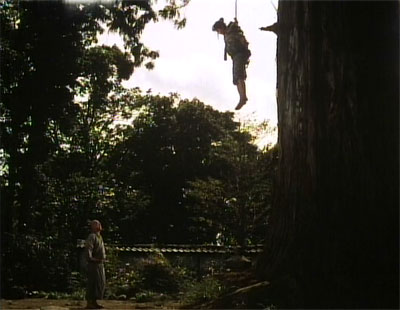
There is an array of supporting characters whose own journeys and motivations add important context to Musashi’s life. His friend Matahachi has more cunning, but is a coward and faithless. Otsu, Matahachi’s former betrothed, is shown to have a strength of character and well of kindness that is likely more instrumental in Takezo’s reform than the Buddhist priest Takuan’s own methods. In the later films this devotion becomes much more prominent, culminating in one of the most Romantic romances of all time.
Takezo is an echo of his time as well, the country was split in war and the Tokugawa Shogunate would emerge victorious at about the same time that Takezo becomes the samurai Musashi. At the end of the film, Musashi is told to go ronin, much like a knight errant, to build his skills and hone his discipline, in order to be fit to serve his master. Setting the stage for the sequel, which I’ll rewatch and review whenever it comes in from the library.
• My review of Samurai II: Duel at Ichijoji Temple.
• My review of Samurai III: Duel at Ganryu Island.
• Criterion Essay by Bruce Eder.
• The Criterion Contraption Review
• Kung-Fu Cinema Review