A part of this viewing list: Criterion Collection Spine #15: Hiroshi Inagaki’s Samurai II: Duel at Ichijoji Temple.
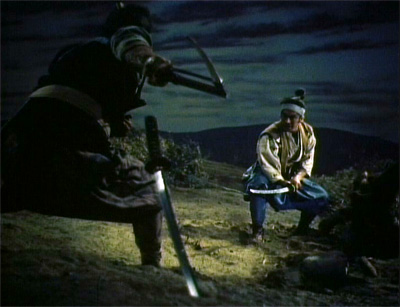
Unintentional Mifunefest continues with the crepuscularly spectacular Samurai II: Duel at Ichijoji Temple. Even as a middle portion of a trilogy this film is strong enough to stand on its own. The lack of firm resolution might have been a problem back in the ’50s but would fit right in with contemporary productions and the viewer is given enough back-story to feel comfortable. Musashi is gone ronin as a training exercise to hone his abilities and to gain the necessary cultured bearing that will enable him to be a true samurai. The focus on character development is just as strong as in the first film, but since Musashi has progressed farther along the road to mastery there are glimpses of the manner in which he will become a legend.
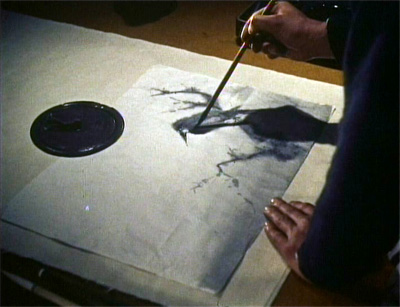
Right from the start we are presented with the problem that Musashi will struggle with throughout the film. It is a continuation of his struggle from the first film to control his strength. A monk he meets at the beginning states that he is true strong, and that a true samurai lives a life of chivalry, which is all that separates him from a common thug. So while Musashi has control of a sort over his power, he as yet does not possess the wisdom to know when to use it, or when to take another path. The people who take him under their wing all provide the puzzle pieces for his advancement. After offending an entire fencing school and killing the brother of its master in a hasty duel, he retreats to the geisha side of town and learns to appreciate music, sumi‑e and the benefits of stillness. Meanwhile all of the supporting characters continue their machinations and quests, Otsu and Akemi are opposite sides of a coin when it comes to their unrequited love of Musashi. The viewer is introduced to the main antagonist, the ambitiously skilled fencer Kojiro Sasaki, who cleverly manipulates the Yoshioka school as a way of testing Musashi’s strength.
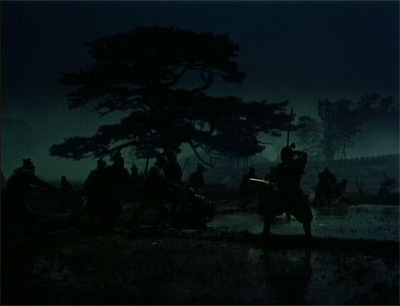
The Yoshioka school publicly proclaims Musashi a coward, which pulls him from hiding. They agree to terms and the master Seijuro will duel Musashi at the pine tree of Ichijoji Temple. Most of the action takes in twilight, and can be seen as something of a reflection of obscured motivations of many of the characters. Although the duel has been arranged in public and fairly, 80 or so Yoshioka students have planned from the start to ambush Musashi on the road to the temple. He catches wind of this from Kojiro-by-way-of-Akemi and decides to pay them a little visit. Then starts the ass-kicking. There is an excellent shot, a pan over the swamp [water is another reflection of feeling in this film] while we here the death cries of Musashi’s enemies in the distance. After killing most of the ambuscaders, Musashi runs into Seijuro [who has finally managed to free himself of the retainers who tried to restrain him], and they fight. Musashi gets Seijuro at his mercy fairly quickly, but instead of killing him outright, he finally realizes that chivalry means always taking the high road. He spares Seijuro and hits the high road with Otsu; eventually settling in the mountains.
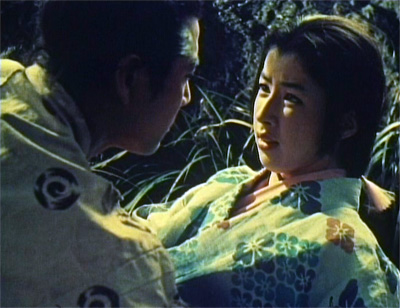
He still isn’t a samurai however, since he nearly rapes Otsu when his repressed feelings burst forth. There is yet another shot of a rushing mountain stream intercut with this sequence. Ashamed of his behavior, and convinced that Otsu is angry at him, Musashi leaves once again to continue his training and strengthen his discipline and wisdom. Kojiro is still out there, and waiting.
• My review of Samurai I: Miyamoto Musashi.
• My review of Samurai III: Duel at Ganryu Island.
• Criterion Essay by Bruce Eder.
• The Criterion Contraption Review.