A part of this viewing list: Criterion Collection Spine #52: Akira Kurosawa’s Yojimbo.
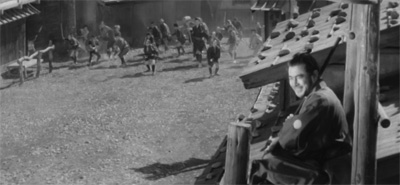
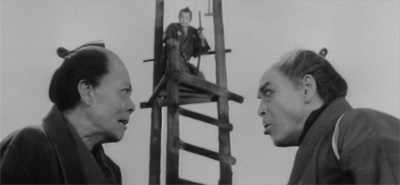
You might know the remake of this film better than Yojimbo itself. Clint Eastwood and Sergio Leone retold it as A Fistful of Dollars. I’ve not actually seen A Fistful of Dollars, but this is the second time I’ve seen Yojimbo. While the film isn’t as deep or ripe for critical analysis as many of Kurosawa’s other works, it also isn’t as shallow and anticlimactic as the Criterion Essay indicates. Alexander Sesonke states that:
Mifune achieved international stardom in Kurosawa’s films of the 1950s, emerging as an actor of compelling power, capable of a great range and subtlety of expression. But as Sanjuro, no subtlety is necessary—sheer physical presence suffices.
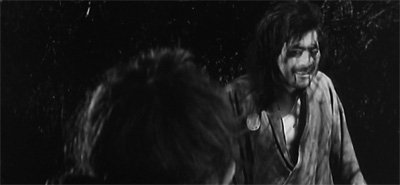
Yet what kept constantly catching my attention was the subtle cunning and glee that Sanjuro takes in playing the warring gangs against each other. He almost always has a smartass grin lurking when open disdain is not present. His physical presence suffices for the two-dimensional supporting characters he manipulates, but the audience and the innkeeper [the only other character to show actual development in the film] are privy to the strategic mastery that is Sanjuro’s true strength.
The innkeeper shouldn’t be disregarded. He is the only person we see in the film that takes an independent role and sees no point in the fighting. His disdain stands in opposite to the undertaker/cooper and Sanjuro’s view of the war as an opportunity. Their different opinions are based on economics, the innkeeper’s custom has been hurt by the fight, while for the undertaker business is booming, but they also reflect the personalities of the characters themselves.
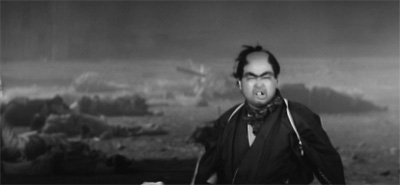
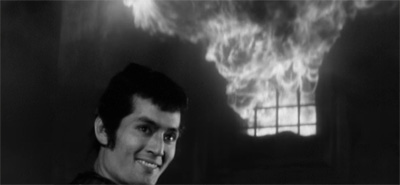
As Sanjuro plays one side against the other, the innkeeper slowly comes to understand that, though he is mercenary, Sanjuro is virtuous underneath. An easy distinction between good and evil would not have caught Sanjuro’s attention the way that the bad versus worse situation that actually exists in the town does. This novelty appeals to a true ronin lifestyle, self-serving but not appearing so, and well-suited to such a maladjusted, misanthropic personality as Sanjuro. Even after he gets his ass handed to him and is near death, his spirit is never more alive. This is where it is easiest to see how Western in intent is Yojimbo; with its particular style of determination and intent. It is somewhat hilarious but not unexpected then, that a film made with deliberate Western influence would be picked up and redone by a Western director. Although there is probably less difference between East and West than modern and traditional.
- Criterion Essay by Alexander Sesonske
- Roger Ebert Essay
- Student Essay comparing the film to Fistful of Dollars
- Critical comparison of Yojimbo and Fistful of Dollars
- A briefer comparison of the films
- YouTube comparsion between a few scenes of Seven Samurai/Magnificent Seven and Yojimbo/Fistful of Dollars