Archive for January, 2007

Down By Law

Wednesday, January 31st, 2007

A part of this viewing list: Criterion Collection Spine #166: Jim Jarmusch’s Down By Law.
dbl1.jpg

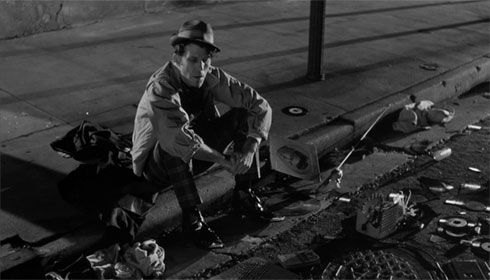
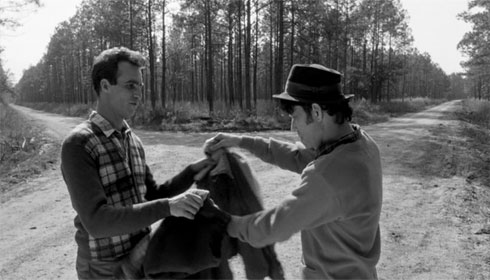
Jim Jarmusch knows how to shoot in black and white. I always forget this until I rewatch something of his. I own Dead Man, and I should probably get my hands on this film as well. Shot in New Orleans, over twenty years ago, its central motivators are timeless. I’m starting to notice this about Criterion Collection films, for the most part the problems that are central to the plots in these films are all of the aforementioned timeless variety. The aspects that qualify the film for their treatment and give variety to the collection [which is slightly humorous considering the amount of samurai flicks that are present] are the distinct spins that are given to something as apparently straightforward as a prison escape film.
dbl2.jpg

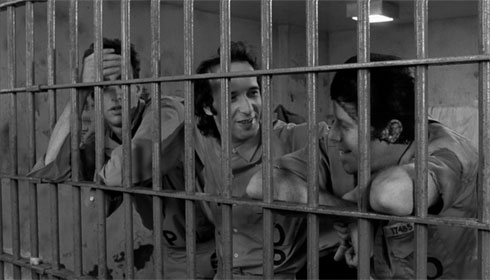
JJ manages this by devoting a relatively large amount of the film’s time to the rising action, before the three main characters even arrive in jail. Similarly inspired is his decision to leave out many parts of the story that are either unnecessary or can be figured out by the viewer. Normally the result of this would be a terse film, but Jarmusch uses the resulting breathing room to examine the private sides of his characters.
dbl3.jpg

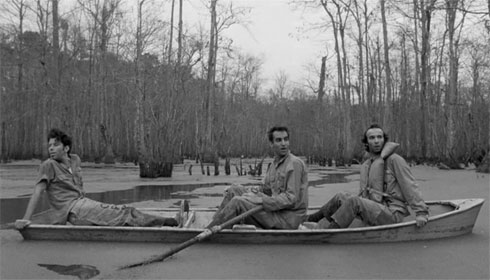
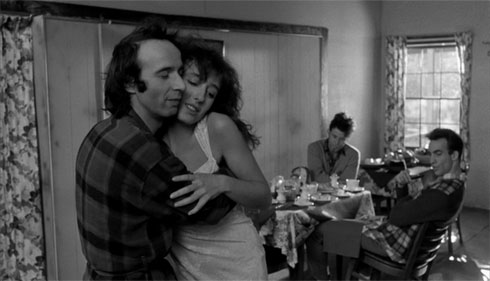
This is easier said than done, since John Lurie and Tom Waits pull off sullen reticence as if it were natural to them. Roberto Benigni acts as a foil to their misanthropy, but also poses a different sort of characterization problem. Jack [Lurie] and Zack [Waits] are too similar in personality but different in application to get along with each other, but the uncertainty that they hide even when alone comes through in their constant fidgeting, day-dreaming and bickering until they eventually recognize their kindred spirit. Benigni’s character Roberto uses his extroversion in the same defensive way that the Jack and Zack use their introversion; by attempting to make friends with everyone and be as expansive as possible, he tries to hide his unease with American culture. All he really does, just like Jack and Zack is make it obvious that he has no idea what is going on in his life.
dbl4.jpg

Their mettles are tempered through the trials of their imprisonment and escape, and while they never become close, the understanding they gain from one another about life and companionship results in a new purpose for each of them. The viewer might not know what that purpose is, but the message is clearly and wryly brought home. We’re all tough enough to get out of whatever trouble we manage to get ourselves into.
dbl5.jpg

Criterion Essay by Luc Sante.
Senses of Cinema article on Jim Jarmusch.
Images Journal review with screenshots.
• YouTube Clips [1, 2, 3].

The Importance of Being Earnest

Tuesday, January 30th, 2007

A part of this viewing list: Criterion Collection Spine #158: Anthony Asquith’s The Importance of Being Earnest.

earnest1.jpg

I have a queer affection for this film. It isn’t my type of film at all, in fact. But it is so deliberately smarmy and the dialogue so witty and refreshing that I quickly forget that I’d want to beat the shit out of these people in real life. Oscar Wilde’s play loses nothing in the hands of Anthony Asquith and his stellar roundup of actors; Michael Redgrave in particular gives a stellar performance. I’m trying to step a bit away from academic analysis in these reviews, but I will say that the film is somewhat of a meta-dialogue since it contains actors playing actors playing characters who are actors. This affectation, and the numerous clever plot twists keep the pace fresh in what are interminably long scenes for film.

earnest2.jpg

In fact, the plot devices, twists and development are so well integrated into the characters’ behavior and Asquith’s portrayal of such, that the end of the film becomes even more startling for its nearly frivolous climax and its appropriately impudent pun. It only comes as an afterthought that such a work was probably a trenchant satire at the time it was written, following in the best traditions of popular English literature. There is much that would have been humorous for its shock value over 100 years ago that has a different sort of humorous applicability in contemporary times. So while the film has a dated feel in terms of content and cinematic style, its fundamentals are strong enough for it to rightly deserve the title of classic.

earnest3.jpg

Criterion Essay by Charles Dennis.
The Oscar Wilde play at Project Gutenberg.
YouTube clips from the film. They’re funny.

Rashômon

Sunday, January 28th, 2007

A part of this viewing list: Criterion Collection Spine #138: Akira Kurosawa’s Rashômon.

rasho1.jpg

There isn’t a whole lot to say in critical terms about Rashômon that hasn’t been said before, and better than I could say it. So instead of talking about it in terms of its examination of truth, its cultural context, or its innovative style, I’m going to review this film in terms of what makes it entertaining; one of those rare foreign films that just about everyone can enjoy. And since Japan decided that films made before 1953 should be released into the public domain, you can watch the entire thing on Google Video. I’ve linked to it below.

rasho2.jpg

Much ado has been made about Toshirô Mifune’s acting as the bandit Tajomaru, but all of the performances are superb. This time around I was struck by the quality of Masayuki Mori’s portrayal of Takehiro, a character whose transformation from story to story is even more wide-ranging than Mifune’s. At least Mifune did not have to play a dead man. This leads to the creepiest part of the film. The testimony of the late Takehiro comes through the employment of a local medium.

rasho3.jpg

Quite possibly the ugliest woman ever, a sequence follows with Takehiro’s lo-fi and tormented voice lip-synched to the medium’s trance thrashings. I hadn’t made connections between this and Ringu, but now that I have it seems almost certain that Ringu takes some of its cues from this scene. The film is full of sex and violence, but it never gets old since the suspense built by the conflicting testimonies refreshes the uncertainty. The use of suspense is worthy of Hitchcock, especially in terms of defying expectation, since just about everyone claims to have killed Takehiro [including Takehiro] instead of the expected denials.

Quite simply, Rashômon is a good movie because its foundation is good storytelling. It becomes a great film due to its additional philosophical examination of truth, but the excellent acting makes this discussion seem natural and the film avoids becoming overly preachy, overly farcical or overly tragic and instead seems as natural as a summer rainstorm.

rasho4.jpg

Criterion Essay by Stephen Prince.
Kurosawa on Rashomon.
Roger Ebert review.
Dan Schneider Review.
Watch the whole movie on Google Video.

Bruce Lee Squarepants

Sunday, January 28th, 2007

I’m watching Spongebob Squarepants right now and it is totally referencing Bruce Lee’s last, uncompleted film Game of Death. where he climbs the pagoda. The whole episode is Sandy Cheeks climbing the pagoda, and she’s even wearing the yellow with black racing stripe jumpsuit that Lee wears.

Man, I’m such a geek.

Playtime

Saturday, January 27th, 2007

A part of this viewing list: Criterion Collection Spine #112: Jacques Tati’s Playtime.

pt1.jpg

M. Hulot is back, at least part-time, for his last appearance in cinema. Playtime continues Tati’s tradition of satirizing the mundane, but unlike M. Hulot’s Holiday, this time the focus is on modernity rather than leisure time. Filmed nearly 15 years after Holiday, Tati has polished Hulot’s mannerisms and now makes him work smarter, not harder when he is on-screen. In fact, there are faux-Hulot’s throughout the film, confusing both the spectator and various characters in the film itself.

pt2.jpg

This sort of refinement increases the enjoyability factor of the film, but it is hard to discover this fact until the very end.. There is quite a bit of slapstick involved, but it is so restrained as to be almost uncomfortable; the sound of hard shoes on a hard floor, the irrational modulations of ventilation systems, the unintelligible murmurs of smalltalk, all combines to make ambient sound its own character in the film. The whole environment of in modern city life creates unintentional hilarity after unintentional hilarity, and part of what strengthens this aspect is that none of the people in the film notice that something funny is happening; a facet that was not present in M. Hulot’s Holiday.

pt3.jpg

Every person in the film seems obsessed with being as modern [and to Tati, as ridiculous] as possible. There is an emphasis on protocol, following the directions of the modern manner and devices, when the old ways would be faster and less prone to confusion. At one point Hulot wanders into a trade show of new inventions and they are possibly the stupidest things ever invented. [e.g. a broom with headlights, a silent door [which sounds alright until you need to slam it for effect]]. The salespersons earnestly display their Ionic column trash cans and pantomime their use, and there are ubiquitous leather chairs that act like whoopee cushions whenever someone so much as touches them. But, all this is “modern” and so overlooked by people doing their best to appear modern themselves.

pt4.jpg

This is infuriating, and it all comes to a head in an interminable sequence at a night club that has opened even though construction on it hasn’t finished. In their haste to be modern they’ve neglected common sense on every level. The chairs ruin people’s clothing, they only had enough food for 27 people, the kitchen is completely unfinished, and the neon sign directs the bounced right back inside. Thankfully everyone thinks this is just part of the restaurant’s modern ambience and play along until the band gets frustrated and leaves. After this climax the people start acting like real people for a change and the atmosphere of the film ceases to be as bland in color [reminiscent of Le samouraï]and affect as it has for most of the film. It ends with a vibrant release of color, a roundabout becomes a carousel, and we get a feeling that there is something sublime about being so ridiculous.

Oh yeah, I almost forgot to mention the reference to Godard’s Breathless that takes place in the film. You couldn’t miss it if you tried.

pt5.jpg

Criterion Essay by Jonathan Rosenbaum.
Roger Ebert Review.
Details on the reconstruction of the 70mm print.
Senses of Cinema article on Tati.
Cinematic Reflections article on the film.
Five clips from the film on YouTube.

Pulled Pork Barbecue

Tuesday, January 23rd, 2007

Sauce Fixins Pork Barbecue is one of my favorite things to eat. Good pork barbecue is one of the toughest things to cook. I gave it my first shot this past weekend, and it turned out better reheated than freshly cooked. I used a recipe from a suspect site, but its simplicity is what drew me to it. I really like to experiment, and this recipe leaves much room for that. I think I’m going to have a few friends over for the Super Bowl and subject them to another go at the barbecue. They liked my ribs from earlier, so they’ll eat anything. More pictures starting here.

Shoot The Piano Player

Monday, January 22nd, 2007

A part of this viewing list: Criterion Collection Spine #315: François Truffaut’s Shoot The Piano Player.

stpp1.jpg

I only have ten more films to rewatch in The Criterion Collection before I can start watching stuff I haven’t seen before again. I’m looking forward to that day. Here’s a little context about Shoot the Piano Player. It is considered part of the French New Wave, and its director, François Truffaut, one of the premier nouvelle vague auteurs. It is based on a pulp fiction novel by David Goodis called Down There. The film is much better than the novel. This is also one of those films that sends academics into sharklike slavering fits due more to its context than its quality. That isn’t to say it is a crummy film. It is very entertaining, poignant, polished and still fresh after nearly 50 years.

stpp2.jpg

But the Möbius strip feedback between the film, its differentiation as French film noir from American film noir, its self-awareness, its obvious undercutting of expectation, and its humor lend the focus more on Truffaut’s direction, the mechanism, rather than the content. That is really only to be expected, since the general content, apart from the aforementioned undercut expectations, is nothing really new. Despite the fact that there is a suicide, a few murders and some kidnapping, a sort of dynamic equilibrium is maintained with brief philosophic interludes and consistent humor. The result is a film that leaves a viewer sated on all fronts, gorged or starved on none.

stpp3.jpg

The most interesting character is, of course, the piano player: Charlie/Edouard. There is a remarkable amount of his character exposition in a film that is only 81 minutes long. At times the viewer is privy to his inner monologue, but ultimately he remains a mystery and his obsession with the piano a simultaneous blessing and curse. Still, this unsolved mystery doesn’t leave any dissatisfaction, as it is obvious that Charlie is content with his lot, as long as there is a piano within finger range. Charlie reminds me of this opening passage:

Current-borne, wave-flung, tugged hugely by the whole might of the ocean, the jellyfish drifts in the tidal abyss. The light shines through it, and the dark enters it. Borne, flung, tugged from anywhere to anywhere, for in the deep sea there is no compass but nearer and farther, higher and lower, the jellyfish hangs and sways; pulses move slight and quick within it, as the vast diurnal pulses beat in the moondriven sea. Hanging, swaying, pulsing, the most vulnerable and insubstantial creature, it has for its defense the violence and power of the whole ocean, to which it has entrusted its being, its going, and its will.

-Ursula K. LeGuin The Lathe of Heaven

stpp4.jpg

While Charlie isn’t quite as passive as a jellyfish, he does have a certain stoic acceptance of the situations he finds himself in. The only time he is visibly agitated is when Lena is in danger. The rest of their characters play their parts, so it really is the manner of the film-making, the gimmick shots, the sight gags, the undercurrent of smartassed French humor that gives the film its pep.

stpp5.jpg

Criterion Essay by Kent Jones.
Carter B. Horsley Review.
Tom Huddleston Review.
Pulp cover of David Goodis’s Down There.
• YouTube clips [1, 2].

Dazed and Confused

Sunday, January 21st, 2007

A part of this viewing list: Criterion Collection Spine #336: Richard Linklater’s Dazed and Confused.

dc1.jpg

Nostalgia isn’t what it used to be.
-Peter De Vries

The screencaps are crummy in this review because the library sent me the Full Screen version instead of the Criterion Collection version. I had to grab screencaps from elsewhere. Dazed and Confused is a movie a bit like Fear and Loathing in Las Vegas in its attempt to recapture the cultural aroma of the 1970s. F&L has an advantage, it is based on primary source material, so its nostalgia is less removed from the decade and despite its rambunctiousness, it comes across as a bit more authentic than Dazed and Confused, perhaps because of the sense of doom that is present throughout the film. D&C on the other hand, is nostalgic for a time that, to me, seems impossible to have ever existed.

In any case, the veracity of the film shouldn’t be a question, it is meant to be nostalgic and entertaining, not some example of truth. What is interesting to me is that the nostalgia present in the film is aimed at my demographic, specifically, folks that probably weren’t even born in 1976. In this case it creates an interesting paradigm, where folks feel nostalgic for a time before they were even born. As irrational as this seems, it can find its purchase in the fact that the film presents a time less fraught with institutionalized worry, pre-War on Drugs, pre-HIV, pre-litigation society, all hassles that were just hitting their stride in the late 80s/early 90s. The 1976 we see in the film haven’t completely forgotten the 60s or even the 50s, in some respects, hot rods have given way to muscle cars, but everyone still goes to the drive-in and pool hall to hang out. The worst thing anyone has to worry about is signing a primitive anti-drug/alcohol/sex/rock and roll pledge in order to play football.

dc2.jpg

The film is a comedy though, such semi-deep thoughts aren’t its focus. Despite the weird nostalgia, the high school archetypes are so well represented that it is almost instinctual to imagine yourself as a certain character or in a certain clique. The retro fad was just picking up when I was in high school, so I had a collection of 70s shirts, orange corduroy bellbottoms and other paraphernalia that could have been spawned by this movie or only just fed by it. As an adolescent rite of passage film it gains an almost timeless appropriateness. You take your allotment of shit from the higher-ups and then they introduce you into the mysteries of High School. I know as a freshman I spent a fair amount of time in a trash can, and as a senior I spent a fair amount of time putting freshmen in trash cans. This is what gives the film its staying power, while it is nostalgic for a high school in a specific time period, it gives enough archetypal examples of high school behavior that anyone who’s been there can relate to it.

dc3.jpg

Criterion Essay by Kent Jones.
Criterion Essay by Jim DeRogatis.
Dazed and Confused.net.
Damox Fansite.
Cinepad review.
• YouTube clips [1, 2].
Wooderson et al. v. Universal Studios Inc. et al.

Gun Show

Thursday, January 18th, 2007

Now that I’ve gotten back into an exercise routine, my old appetite is coming back. Yesterday after lifting weights I was ravenous. I ended up getting a 3 egg omelet with home fries and a side of fruit salad for breakfast from Juji’s. Lunch was light, a peanut-butter protein smoothie from Octane, but I had two dinners. A mess of broccoli and feta with some smoked sausage, and then a bit later, a big bowl of oatmeal and some toast. I was just as hungry when I woke up this morning as well.

Unless I’ve forgotten just how much I can eat, I think my appetite might actually be larger than usual. This has got to be due to the fact that I’m lifting weights consistently for the first time in, well, ever. My upper body is so not-buff that my body must be going through something akin to the rejuvenation that took place to my left leg once I could start the recuperating from my second kneecap dislocation. Since I’ve got significant help from the gym, I’m also not worried that I’ll injure myself due to ignorance. I don’t feel buff yet, but just wait until I start carrying around empty pop cans so I can crush them against my head.

Hiroshima mon amour

Wednesday, January 17th, 2007

A part of this viewing list: Criterion Collection Spine #196: Alain Resnais’s Hiroshima mon amour.

hma1.jpg

Rien is, perhaps, the most beautiful word in French. In Hiroshima mon amour such words of emptiness and loss echo throughout. The opening sequence in particular is stunning for its evocation and dialogue; it is so full of implication that the viewer immediately succumbs to its intensity. Two post-coital lovers, one Japanese, one French, are debating the epistemology of Hiroshima. The dialogue is simple but the evocation complex; raising questions as startling as: Is empathy ultimately a form naïveté? What does it mean to claim to have seen Hiroshima, a thing that the Japanese man emphatically denies is possible? During this discussion he images on screen are attempting to show us Hiroshima, and although it would seem they are refuting the Japanese man’s point, they emphasize it — showing what used to be Hiroshima — the subtle con of authentic replica. The juxtaposition continues when the woman describes flowers blooming in Hiroshima while the screen shows stock footage of radiation horrors, crumpled buildings, lame dogs, and people rotting alive. Even the constantly shifting score keeps the viewer from grasping Resnais aim, which was probably Resnais’s aim, at this point in the film. The quicker the viewer is completely unbound from a stable emotional state, the better.

hma2.jpg

When the love story kicks in it is possible to begin to understand why the dialogue sounds like poetry; the characters are near to bursting with pent up emotion. We know already that the unimaginable and unexpected power of the Hiroshima bomb has left ineradicable marks on the Japanese man, but now we begin to sense [and glimpse] that there might be a similar situation in the woman’s past. Getting to the meat of the inquiry takes some digging, the film has levels within levels, like an onion or a parfait. It turns out that the woman is in town because she’s an actress in a film about peace, a fact that is mentioned a few times as if Resnais’s repetitions are intended highlight another sort of self-reflexive naïveté, Can a film about peace alter the truth of Hiroshima? As the staged peace parade proceeds, it is filmed as if it was a part of the film within the film; thus completing the self-reflexive circle, Can Resnais make a film about peace that alter’s the truth of Hiroshima?

hma3.jpg

As the flashback sequences begin to unravel in longshot, as counterpoint to the consistent closeups that take place in real time, the focus of the story becomes less on Hiroshima and more on the woman’s past as a French girl with a German lover in Nevers during the war fourteen years ago. Her trauma is more personal, but no less devastating than the man’s. [There are deliberately no names in this film.] It begins to come clear that maybe she did have her own private Hiroshima. As terrible as this is, the true emotional toll continues, she has begun to forget the details of her lover. The man refers to her as “the symbol of love’s forgetfulness.” For him, the ability to forget Hiroshima is a source of relief, not the terror that the woman feels in her loss of Nevers. She repels him but he pursues, another set of opposite reactions that occur as they begin to understand each other. At the moment of truth they name each other: Hiroshima and Nevers.

hma4.jpg

It would almost seem that Resnais laid a false trail in the fascinating opening sequence and the questions it raises. I think it was necessary for a few reasons. If we weren’t hooked from the first bite, the movie would have ended up being godawfully boring. But more importantly, the context it lays and the apparent misunderstandings and tough questions become respectively internalized and discarded as the true meanings emerge. I’m not going to drop a moral at the end of this review like Aesop; that would be a disservice to the film, which offers no obvious moral. Just watch it and decide for yourself.

hma5.jpg

Criterion Essay by Kent Jones.
Name-dropping review at Pop Matters.
• Clips on YouTube: [1, 2, 3].

Duplicate

Tuesday, January 16th, 2007

What is interesting about this post is that I tried to post it via YouTube’s Wordpress API. After hitting submit, I was given a notice that there would be a delay before posting. I figured they meant a few minutes. Apparently they meant two days. I won’t be using THAT functionality again.

Soft Spots

I saw Soft Spots, formerly Friend, formerly Little Songs at the Beachland last night. In the short time they’ve been together, their music, which was good to begin with, has gotten so much better. They might actually have tied up the race for favorite Cleveland band with TMIBH. The only reason I can’t make a decision is because the types of music are so different.

In any case, the show last night was great, they asked the audience to sit through the show blindfolded and many did, although I did hear a story about some dude getting groped by an unblindfolded woman after the set was done.

I had prime seating, even though I was blindfolded, and I took this video of a song called “Flora”. They played my favorite song, Tess, but I wasn’t quick enough on the uptake to record it.

Fear and Loathing in Las Vegas

Monday, January 15th, 2007

A part of this viewing list: Criterion Collection Spine #175: Terry Gilliam’s Fear and Loathing in Las Vegas.

fllv1.jpg

America is the first country to have gone from barbarism to decadence without the usual intervening period of civilization.
—Oscar Wilde

I’ve never used any sort of illegal drug, so offering an examination of the verisimilitude of Hunter S. Thompson’s and Terry Gilliam’s portrayal of drug-induced behavior isn’t going to happen. I also thought about writing this review as HST himself would have written it, but that would be [possibly] the worst thing I have ever written. Anyway. This film and book are about as American as they come. I’m not talking about a mythologized America, although that is present, or a nostalgized America [also present], but a subtle simulacrum of the actual American psyche. I’m going to talk about the film and the book interchangeably, since Gilliam’s presentation is generally spot on. They are about pursuing the American Dream and getting lost along the way, something that eventually happens to all of us. In the film, the American flag, in the hyperbolically American city of Las Vegas, literally litters most scenes. It is trampled, blanketed, torn and ignored for virtually the entire film, as the main characters go on their vision quest for the reality behind the symbol. Failing at that, they revel, albeit paranoically, in their drug-induced haze until, abruptly emerging into the glare of the desert, they are left with a feeling of satisfaction, despite not knowing how they’ve arrived at it. Count the commas.

fllv2.jpg

He who makes a beast of himself
Gets rid of the pain
Of being a man.
—Dr. Johnson

The drug-driven self-reflective atavism becomes a rhythmic counterpoint to the ostensibly noble pursuit which Dr. Gonzo and Duke claim to be chasing. Yet even this itself is a very American situation. The pendulum between barbarism and decadence. When the film swings to the animal end it shows the more realistic aspects of Americana: violence, sex, rage and power. But here there are also moments of an almost primeval quiet, the quiet that Duke is constantly seeking and which seems to offer him continual epiphanies. At the famous “wave speech” Duke realizes that he’s not going to find/beat the American Dream though he is now far too committed to simply give up. Perhaps his manic glee at the end of the film is the result of his realization that although he didn’t beat the American Dream, he at least fought it to a draw.

fllv3.jpg

And as serious as this review has been, the fact that this film and this book are comedies should not be neglected. In fact, the comedy is the icing on the cake in terms of the American-ness of the film. My mom would say that the film has a smart mouth, but the kind of lip it keeps giving is salty for a reason. Gilliam and Thompson knew they outcome was futile, so true to American form they cloak the deadly earnestness with a dismissive attitude. At some level we all feel that the truth lives with the barbarians and the ideals with the decadent; never shall the twain meet. Fear and Loathing is more ethnography than acid trip.

fllv4.jpg

Criterion Essay by J. Hoberman.
Jacket copy for the book by Hunter S. Thompson.
Fear Under The Microscope: A Comparison of the Terry Gilliam/Tony Grisoni and Alex Cox/Tod Davies screenplays for Fear and Loathing in Las Vegas.
Gilliam Grisoni Screenplay.
Tons of clips on YouTube.
Lots of journalism on the film from the Las Vegas Sun.

Soft Spots

Sunday, January 14th, 2007

I saw Soft Spots, formerly Friend, formerly Little Songs at the Beachland last night. They’ve quickly become one of my favorite Cleveland bands, if not the favorite. They started less than a year ago, and their music, already good to begin with, has only tightened and matured with age. They blindfolded the willing last night and played their full set to a crowd of people who couldn’t see them. I was one, could only see a little bit from the bottom of the blindfold; so it is amazing that the video of their song “Flora” turned out as well as it did. They also played my favorite song, “Tess”, but I was slow on the uptake and didn’t get a chance to record it.

Prophylactic

Saturday, January 13th, 2007

Probably my favorite thing about Rafeeq is that he tells his truth and damn you if you can’t handle it. The other night at his reading at the Lit he told us that unless we write from personal experience and belief our stuff is going to continue sucking. I’ve been really struggling with writing lately, and I think this is because I’ve been trying to train myself into some sort of conformity to status quo and acceptable emotion. I’ve been putting an emotional condom on my poetry. Rafeeq’s stuff is very personal, and reading it in front of a bunch of white folks who’ve probably never even seen the inside of a jail cell must seem so futile. Paraphrasing, he said that though we might appreciate his writing, we can’t empathize with it, and that’s very true. I’ve never seen the inside of a jail cell, and while I can’t empathize with the experience, I can empathize with the frustration that he must sometimes feel. I’m just grateful that he’s sometimes willing to share those strange sides to me. Once Andy posts the video of Rafeeq I’ll link to it here.

Final Destination

Thursday, January 11th, 2007

I’ve almost been run over twice more since the near miss two days ago. Yesterday I was walking to the gym, about ¾ of the way across W. 4th Street when some guy in a z4 nearly clips my feet off turning onto W. 4th. He probably took that corner at about 30mph, which is impressive considering the fact that W. 4th is about 15ft wide. In anything other than a sports car he would have had to slow down.

This morning I was waiting for the 23 and it was coming, so I stepped up to the curb bus stop. It didn’t even slow down, and its corner almost clipped me and another dude that was standing there. I feel like I’m in a stupid horror movie.

Perpendicular

Tuesday, January 9th, 2007

They say that if there is a hit our for you, you’re supposed to avoid routine, take different routes to work, never shop in the same place twice, move often. I walk a different route to work each day along the same street. Euclid has been undergoing infrastructure surgery for quite some time. When morning comes I wonder which sidewalk will be closed, which homeless man will be displaced from his corner and which storefront is going to be a bit more torporous. Currently some pipes that were worked on less than a month ago are being excavated from sidewalk that was laid last week. This seems to be standard procedure. Whatever seems pristine must be hiding something. This seems strange in a world where straight is the only direction it is possible to travel. Later, my boss and I were almost crushed by a semi that cruised through an old red light.

Initiative

Monday, January 8th, 2007

People keep telling me to run for an elected office, and my automatic response is always leeriness. The hierarchical nature of any bureaucracy restricts initiative and that’s my main strength. There’s also always too much talk and too little action. I’ve been to far too many meetings and read far too many weblogs where people feel perfectly comfortable telling how things should be, but do no work themselves to make those things come about. Actionless policy ideologues are really just public masturbators.

My mother used to always sing the patience song to me, but it never stuck, and my natural impatience becomes initiative when I put it into action. I can’t count the number of times this year that people have asked me if I’m running for the board of TWDC. There was a time when I thought that working for TWDC would be good for me and the neighborhood, but now I can better appreciate the strengths of unaffiliation; much in the same way that I refuse to be affiliated with a political party. I don’t have to play favorites, focus my work on appeasing someone’s ego, or lick any boots. I’m my own boss and I get much more accomplished that way.

Notre Dame Fencing on NPR

Sunday, January 7th, 2007

Thanks to a heads up from Jeff Hess, I had the opportunity to listen to a piece on NPR about Notre Dame Fencing. You can listen to it by clicking here. It is a RealPlayer proprietary format, but you can get around that by using Real Alternative.

It’s a pretty accurate piece, no one knew about the team when I was there either. Heh.

Mark Elf

Saturday, January 6th, 2007

So I did a mild redesign. Not much changed on the front end, but I basically coded this one from scratch and it is 50% less crufty and 50% more cromulent than before.

I had a half-formed thought last night about how moments are precious because most of them get lost to memory during the abyss of time that is life; life always seems short because we forget most of it. So each moment has to be used up to the last nubbin, because even if we forget it, we’ll know it wasn’t wasted.

Guilty Pleasures

Friday, January 5th, 2007

• Joining various indie-rock Soulseek chat rooms and asking people if they have X song by Y artist that is on the Top 40 list and acting all hurt and offended when they tell me they don’t listen to that crap and to chrissakes try the search function you dumbfuck.
• XHTML strict web design.
• It’s Been Awhile by Staind, Dead or Alive by Bon Jovi, Spice Up Your Life by The Spice Girls, How You Remind Me by Nickelback, Billy Joel, Queen.
• Kraft Singles.
• Irish exits.
• Saying deliberately ambiguous/mean things that can be taken seriously or not seriously and leaving the other person to figure out which I truly mean. You know who you are.

Crafty

Thursday, January 4th, 2007

DSC01494I have home internet access again for the first time in nearly two years. Hopefully I’m enough used to not having it that I’ll forget that I can be completely unproductive by surfing all day. I do have quite a bit of web-catching-up to do. All is nearly back on schedule.

I’ve started doing a bit of collage stuff on boxes and couldn’t tell anybody about it until the first one had been delivered as a Christmas present. Of course I’ll be posting things as they’re done, all in the Crafty set of my Flickr account.