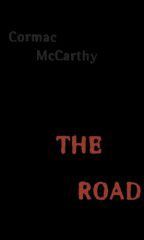
 I ordered The Road from the library a day before I found out it won the Pulitzer, because of a year-old review from an old copy of Stop Smiling that I picked up at Pitchfork. The Pulitzer notification, coming as it did from a thread about literary critics and their derision for genre fiction, stayed in my mind as I read the book. It is the first thing that I’ve read by Cormac McCarthy, and I picked it up because the Stop Smiling review indicated to me that it was science fiction written by a non-sci-fi author.
What is immediately evident is that McCarthy doesn’t care for traditional reading cues like quotation marks around dialogue and chapter breaks. I’m a big fan of experimental novels, but at times in The Road it is very difficult to figure out who is talking to whom. Similarly, no character has a proper name. In fact, I don’t think there is a proper noun in the entire book. So when the man runs into another man and they talk to each other or have a tussle it is pretty much impossible to figure out who is doing what. The writing itself is often superb, but it seems to stumble just as regularly, as when words like ensepulchraled and crozzled sit together in the same sentence and have lunch. The quality of the writing doesn’t enhance or uphold the plot either, which to me seems like a fairly large problem, since I read books for the stories, not the writing. What I mean is that McCarthy seems interested in writing interestingly for its own sake and using the story itself to manipulate the reader into a certain mindset as opposed to writing and developing a plot purely for the sake of storytelling.
It could be argued and I would agree with the assertion that all story-telling is a manipulation of the audience, but what I’m thinking is that McCarthy is more interested in evoking a specific emotional reaction from his audience than telling the story. It is a determination of vectors. The story is about a man and a boy in a post-apocalyptic world [just what destroyed the world is unclear, but from inference I gather that it was some sort of meteor impact] where everything is dead except for a few other humans, and life is hiding from the others and scavenging canned goods.
They boy and man are dependent upon each other, but as the book progresses it becomes evident that the boy is the one best suited and morally understanding enough to live in this new world. The man cannot let the past go. The boy has no memory of it. The basic plot actions are easily foreseen; you know they’re going to find a fall-out shelter and that this will be the high point of the narrative, you know that their belongings will be stolen, you know that at least one of them will die [most likely the man, due to various other clues] and that this will be the low point of the narrative.
In the end, I wasn’t that impressed. The writing was excellent about half the time, but the story never got me going. I’ve read more effective and better written apocalyptic literature, and stories with just as much despair in less than the 241 pages of The Road. The dust jacket said this would be McCarthy’s masterpiece, and if that’s the case, I’ll pass on the rest of his stuff.