Archive for August, 2007

Les Diaboliques

Thursday, August 30th, 2007

A part of this viewing list: Criterion Collection Spine #35: Henri-Georges Clouzot’s Les Diaboliques.
bolique1.jpg

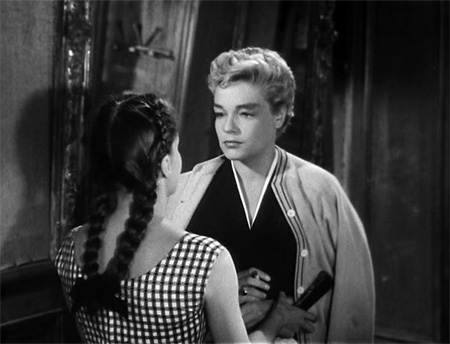
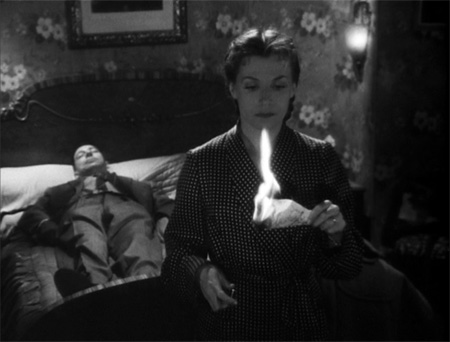
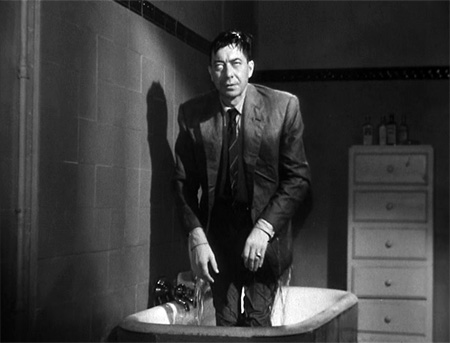
This movie is amazing. I’m not one for horror movies, because I never get scared, but the ending sequence of this film even creeped me out. Pretty much any time you hear anything about this film there will be the inevitable comparisons with Hitchcock and the statement that this film inspired him to make Psycho. Thankfully I haven’t seen Psycho yet and am therefore unqualified to talk about that. What I am qualified to talk about is the total awesomeness of this film. These two women, a wife and mistress, plot and kill the man who abuses them and rapes them and beats them. They’ve got a great alibi and all that, they dump the body into the dirty swimming pool of the boarding school they run/work at. The pool gets drained and the body is nowhere to be found. Then people and things start happening that insinuate that Monsieur de Lassalle is still alive and kicking. This must be impossible, since he was drugged, drowned and then held underwater all night by a big bronze statue.
bolique2.jpg

Clouzot’s extreme filmmaking excellence is so effortless that it is hard to feel the suspense creeping up on you until the money shot at the end. This shot was so good I had to watch it about a dozen times. You can see it in the YouTube clip linked at the end if you don’t mind spoiling the movie for yourself. Basically what happens [and this isn't a spoiler] is that Mrs. de Lassalle thinks someone is in the school at night and is creeping down the hallway at night. She puts her back to a door which we know someone is behind and look-listens her attention down another hallway. Then the camera pans away from her and slowly tracks around to reveal the extent of the hallway. It doesn’t sound too spectacular but it works on so many levels that for me it is definitely the money shot of the film, no matter what came after it.
bolique3.jpg

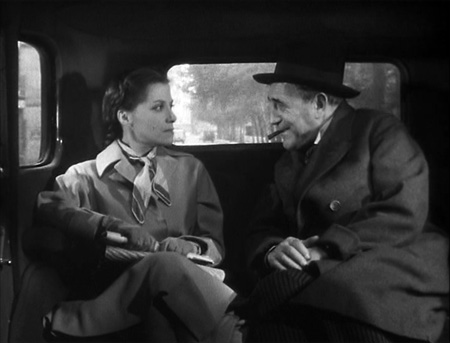
The reason this shot is so spectacular is because on top of all the traditional weight of suspense embodied in the “what’s down the darkened hallway” cliché we have the dramatic irony of knowing where figure of suspense is located; right behind the heroine. When the camera moves away from her there is a torturous foreknowledge that something horrible is going to happen to her, and that we won’t get to see it! The viewer, at the height of suspense and tension in the movie, is essentially told that they will get no satisfaction. Then the movie kicks back into gear and we eventually do get satisfaction, but that pan and track would have made the movie worth watching even if all the rest of it had sucked. Plus, Vera Clouzot, who played Mrs. de Lassalle is quite attractive and wearing a see-through nightgown. Clouzot’s reference to actors as “instruments” is not as insulting as it seems, for these instruments, it is an honor to be held in the hands of a master.
bolique4.jpg

Roundup

Thursday, August 30th, 2007

In other gym-related news, there is this dude who I’ve seen at the gym since I started going there that never lifts weights. He dicks around the entire time, almost always looking at himself in the mirror and going through the motions of lifting weights, setting up the bar, adjusting seat heights, switching out handles and weights, cleaning the bench, sitting down and getting “in the zone”, but never actually doing a set or even a rep. He spends something like an hour in the locker room, grooming and combing his hair and shit too. I once showed up and he was in the locker room combing his hair, did my approximately one-hour workout, and when I went to the locker room he was still combing his hair. Weird thing is, the guy is frigging ripped, so he must actually lift sometime.

Saloio bread is gross. I picked up a loaf from Dave’s because it seemed to be the closest bakery approximation to whole wheat, since they were out of the latter. It is salty as hell, crumbly, dense, and chewy. It tastes worse than the homemade hosts that Fr. Stan makes back at St. Gabriel’s in Connersville. Never again.

I get so much weird junk mail about mortgages now that I’m a homeowner. A lot of it is obvious scam stuff about PMI and refinancing, but some of it is not so obvious scam stuff that looks like official documentation from Fifth Third. Today however, I received a scratch off ticket. It says on the ticket that all tickets are winners for stuff like an xBox or iPod Video, the only obligation is to sit through a demonstration of some home care products. Fat chance.

I also both like and have a crush on someone. :)

Impromptu

Tuesday, August 28th, 2007

Lou shot me an email today to help him restore his WordPress after his site was hacked, he came over right after I got home and we fixed it fairly quickly. Then he and I met up with Shawn at the Lincoln Park Pub for Taco Tuesday and I ran into my old boss. Found out she reads this and has been keeping tabs. Hi boss. Had some tacos, met some new folks, shot the shit and had a nice relaxing time for a couple of hours. That’s the kind of society I dig. Spontaneous, chill, hilarious, food.

Married women have been hitting on me the last few days. I was at my friend Sandy’s birthday party on Saturday and Amy and I both got the vibe that this runway catalog modelish woman was flirting with me. Then, at the gym today, this other lady kept moving to work out in front of me and checking to see if I was looking at her and asked me if I was getting a good workout. Wedding ring on the finger. Maybe they aren’t hitting on me [postulate] and I’ve an enormous ego [fact] or they feel like I’m safe to flirt at [postulate] when the hubs isn’t around. This is just as strange as getting hit on by gay guys while running was a year ago; but not as funny. My current boss says that being married doesn’t mean what it used to, and that expectation that married folks are going to cheat troubles me.

M

Tuesday, August 28th, 2007

A part of this viewing list: Criterion Collection Spine #30: Fritz Lang’s M.

m1.jpg

Fritz Lang always blows my mind. The precise craftmanship in all of his films, the exactly correct framing for a shot, the inspired, slight, understated camera movements, the chiaroscuro and beauty of the black and white would be worth watching in a film without anything resembling a plot. But Lang is not merely good at one or two aspects of filmmaking. He is good at making films, complete worlds unto themselves. M is a world of suspicion, where neighbors are encouraged in paranoia and tale-bearing, where the innocuous becomes sinister, and a budding fascist government controls the public through its efforts to find and stop a faceless enemy. It was made in 1931, anticipating the Third Reich by a few years. That’s just the macro level. On the micro level, the psychological portrait of a child-killer is immediately abhorrent and understandable, and the steps into Hans Beckert’s [played wonderfully by Peter Lorre] mind are so well-written, portrayed, apt and surprisingly potent that the film, which is largely run-of-the-mill police procedural for the most part, culminates in an unexpected explosion of emotion that a viewer is left with something approximating a thousand-yard stare.

m2.jpg

If we have to pick one word for this film to be about, it is likely repression. The reason Beckert acts as he does, even though he knows he is mad and should not, is because he has no option in his society but to repress his reprehensible desires. Even a verbal expression of his desire to have sex with little girls and then murder them is so outside the norm that it would likely cost him his life or at least a few teeth. Stuck as he was, forced to internalize and cocoon himself from the everyday of everyone else, it is unsurprising that he would essentially disappear, so innocuous that no clues appear apart from his habit of whistling Peer Gynt as he seeks new prey. Similarly, his writing of a letter to the police, and then the papers attests to his desire, no matter how now malformed, to have communication with society at large. This is all possible to learn without actually seeing his face, or hearing him speak. Sound was a relatively new feature in film at this time, and its ambient use by Lang, its appropriate and heightening omissions, and its laconic dialogue make the final soliloquy by Beckert all the more effective.

m3.jpg

The fact that even the criminals, societal edge-cases themselves, want to destroy Beckert with no qualms is telling to his extreme deviance. Yet, when he explains the motivations and guilt that drive and torment him, heads nod even among the kangaroo court. These are people who know what it is to sin, though for the most part they can control it. The coda is so terse that it was either meant to be that way or some of the missing footage belongs at the end of the film, but no matter the reason, it attests simultaneously to the paradoxical ethical and reasoning satisfaction of the rule of law and the passionate, emotional dissatisfaction of justice not being served. The tale of serial killer becomes analogous to the life of every person, only taken to an extreme; and the character sketch of a doubly fear-driven society adds another facet to Lang’s idea that vice and viciousness are all too easily encouraged with any person.

m4.jpg

Time Bandits

Tuesday, August 28th, 2007

A part of this viewing list: Criterion Collection Spine #37: Terry Gilliam’s Time Bandits.

timeband1.jpg

Woops. This movie totally didn’t do a damn thing for me. And usually I really like Terry Gilliam. I would have preferred something like The Adventures of Baron Munchausen as the Criterion pick, if they were going to go with a Gilliam kid’s movie, since that film is both entertaining, wonderful and well made. Time Bandits doesn’t seem like any of those to me, but I’m hoping that it was necessary practice for Gilliam in order for him to produce Munchausen. It is a pretty good children’s film, although the characteristic Gilliam darkness might focus the demographic on older children. A younger one might not understand the whimsical Napoleon, the technocratic declamations of Evil or cope with the explosive ending of the parents. The film certainly doesn’t strike me as something funny. Silly, definitely, children will laugh at the dancing dwarves, but actual humor is rarely to be found. It is Monty Python without the punch.

timeband2.jpg

The filmmaking is Gilliam™; a sort of steampunkesque magical realism, where things like knights breaking through wardrobes in 20th century Britain seem plausible mainly because the sets are as banal as real life and the future already appears obsolete. What I mean is that a viewer doesn’t have to suspend disbelief to see and enter into a room that looks like what any boy’s room looked like in 1981, and when the magic occurs, it is the type of magic that a boy would imagine happening in his room. Gilliam never dives too deeply into the rich territory he presents. Instead the constant flitting about allows him to keep the film at a level that children can understand and that also appears to be a bit dreamlike; setting up the “it was only a dream, or was it?” cliché ending.

timeband3.jpg

It often seem like Gilliam keeps making movies in attempts to either elucidate a complicated thought or pin down a specific worldview that is his Truth. He’s ambitious, in the respect that his goal appears to be a unified theory, whereas other directors are content with the explication of a small piece of truth. Gilliam is a philosopher who accidentally became a filmmaker and uses that medium as his thesis vehicle. He certainly seems to express a Camusian existentialist absurdity, focused less on the absurdity of existence period, and instead on the absurdity of existence now. And while this idea that humans waste their lives convincing and dreaming about better things provides frustration, the fact that these fantasy escapes are often better than actual life, and the fact that Gilliam is a creator and purveyor of such fancifuls is an irony that I am certain Gilliam is aware of.

timeband4.jpg

Nifflas’ Games

Tuesday, August 28th, 2007

Nifflas’ Games

Lord of the Flies

Saturday, August 25th, 2007

A part of this viewing list: Criterion Collection Spine #43: Peter Brook’s Lord of the Flies.

flies1.jpg

It is tough getting children to act well; just ask anyone who’s ever had to get children to act well. A vast majority of the cast in Lord of the Flies couldn’t act their way out of a wet paper bag, but thanks to Peter Brook’s careful planning and choreographing of key scenes, and relaxed improvisational allowance in others, the awkward acting ability morphs into an appropriate skittishness for adolescent maroons. This adaptation is well on the mark of the book, with an added intensity of visceral imagery and psychological warfare that only film can provide so effectively. The main strength of the film is that it was shot entirely on location, apart from the opening montage, and the reality of the island setting feeds into the reality of the characters’ development. Without the imposing hand of civilization, regressing to a wild and savage state becomes easy.

flies2.jpg

Lord of the Flies is not only a tract about the importance of civilization, but also an interesting thought-experiment on the emergence of new cultural forms. In the film, this is noticeable fairly soon, as the political rifts between the two leading boys, Jack and Ralph, are a microcosm of international political strife. Similarly, the creation of ritual chants and activities to ward off the beastie, and Jack’s clever manipulation of their fear to maintain control have contemporary parallels in our own country. This is no new trick, but its efficacy ensures its continued use. The cognitive dissonance and linguistic lacunae in their vocabulary after the first murder takes place is also telling in terms of their fear. Similarly, the development of face-paint and little to no clothing are marked changes from their initial school-boy attire.

flies3.jpg

Still, there are similarities between before and after. The choirboys become the hunters and their discipline, organization, and loyalty as the latter is due directly to their training in the former. They are also the ones who create and enforce the cultural progression of the tribe of boys, while Ralph and Piggy, who’ve maintained their reason to some extent, are increasingly ostracized. All of this terror comes through strongly through the use of liberal cutting and realignments in the editing room, and the sheer amount of footage Brook had on hand to pick and choose from. The final scene is so abhorrent , as Ralph flees the other youths on all fours, much like the pig they are convincing themselves he is, that the appearance of white socks and matching deck shoes of adult proportions, and the adult that is wearing them is a great relief. The monster we’ve only caught glimpses of, the monster that was about to appear in full and terrible force, especially because of its familiarity, is slain just like that.

flies4.jpg

Jon Hicks Design, Paleo, Chum

Saturday, August 25th, 2007

Jon Hicks has a show of his concert posters at B-Sides under the Grog Shop. Last night was the opening and a free show by mostly local bands upstairs. Mystery of Two, Paleo, Brian Straw, Chum and Blk Tygr all put on great shows. I really need to get a better low-light camera if I’m going to be taking video of performances at these places. Pretty much all that turned out was Paleo and Chum, which you can watch below.

I ended up buying Paleo’s DVD/CD which contains 365 songs that he wrote and recorded, one a day, for an entire year while touring around the States.

Chum was Chum, with some substitutions due to broke-armed bandmates. They rocked it well and truly.

Ill Doctrine

Friday, August 24th, 2007

Ill Doctrine

The Most Dangerous Game

Friday, August 24th, 2007

A part of this viewing list: Criterion Collection Spine #46: Irving Pichel, and Ernest B. Schoedsack’s The Most Dangerous Game.

mostgame1.jpg

As soon as this film kicked in, I realized that it was an adaptation of Richard Connell’s short story that I’d read years ago, loved and lost. So, I was excited to see how it would play out. The adaptation is fairly faithful, with the seemingly always necessary addition of a love interest [Hurrah Fay Wray!] to make it a bit more mass-appealing. The only downsides to this additive are the super-annoying brother and the overuse of poorly done soft focus anytime the camera got near Ms. Wray. Clocking in at 62 minutes, the film is also a bit on the short side. After two British by British adaptations Lean on Dickens in Great Expectations and Oliver Twist, the brashness and lack of subtlety in this American production is quite a change. In the first 8 minutes there are at least half a dozen intimations of doom and some immediate cosmic irony; a shipwreck, explosion and a couple of shark attacks. It is almost hilarious in its blatancy.

mostgame2.jpg

But, this is a horror movie, from Hollywood’s Golden Age so we’re supposed to be scared. The protagonist is a famous big game hunter and author so we know he’s capable of surviving a shipwreck on a small island in the South Pacific. Dude ends up at the fortress of a lunatic Kossack and his crazy cohorts, discovers a herd of Great Danes that look like they were recycled [in costume] 27 years later in The Killer Shrews and a drunk New Yorker that you want to be murdered about 2 minutes after his introduction. It is apparent right from the getgo that all the non-shipwrecked folks are bloodthirsty degenerates, but Our Hero is so wooden and bad acting that he doesn’t buy anything until he sees the shriveled heads in the trophy room. This discovery, and the welcome murder of Annoying Drunk American Guy, get dude booted out with a hunting knife and Fay Wray to take care of in the harsh jungle. Fay Wray’s presence is a bonus, because her dress gets skimpier and more falling-offier in every scene.

mostgame3.jpg

Dude wins and Kossack guy dies, of course. Fay Wray and hunter dude boat off into the sunset. What is startling and ahead of its time for the film, is due mainly to the story. It is a fairly effective argument against big game hunting and animal cruelty. By placing a human in that same situation, Our Hero realizes that being hunted is not the same as being the hunter. This ends up making his final fight with Count Kossack more interesting than usual because he has a light in his eye like a wild animal might have. So while his acting was pretty terrible throughout, he mitigates that to some extent at the end. If you can’t tell, I wasn’t too impressed with the film. The print Criterion got its hands on wasn’t that good, and the flaws in the filmmaking are consistent enough that it is obvious that either Pichel or Schoedsack didn’t really have a handle on movie-making. It would have been a great film without those hiccoughs [and 20 minutes more plot to cud on].

mostgame4.jpg

Balls Out

Friday, August 24th, 2007

That’s what I think of TV News

Oliver Twist

Thursday, August 23rd, 2007

A part of this viewing list: Criterion Collection Spine #32: David Lean’s Oliver Twist.

ot1.jpg

Two years after David Lean’s Great Expectations, Alec Guinness is back in another Dickens adaptation. This time he’s very aged through makeup and a giant prosthetic nose [that got the film denounced as anti-Semitic], but his portrayal of Fagin really shows off his particular acting chops. His struck posed eccentricity steals the show in every scene he’s in, although sometimes the beautiful Nancy gives him a run for his money. I’m only familiar with the Oliver Twist tale in terms of modern cultural references, like Chef Boyardee commercials. Yet it seems as if the same [albeit small] issues that were found in Great Expectations are here as well. Namely, the inconsistent use of intertitles as narrative cues, and obvious plot excisions to remain true to the core story. Where this film astounds is in the cinematography. Much more varied than Great Expectations, dutch angles, subjective camera-work and amazing approximations of natural light make the film beautiful to watch even when the action gets a bit boring and predictable.

ot2.jpg

The artistry that I claimed hard to find in most of Lean’s work is always evident here. From the German Expressionist reminiscent London exteriors, to metaphorical shots that reflect pain or violence, like the opening scene’s shot of thorned branches cut to a woman in labor pains, to a later scene where a woman’s murder happens offscreen while a dog scrabbles and yelps to run out of the room. Where Great Expectations was psychologically charged, Oliver Twist is more concerned with physical abuse. Although the film is quite violent, however, it never really seems as though Oliver has it that badly off. Especially since we know how tired the trope of down-on-his-luck makes good is. This isn’t the fault of the movie, but a necessary expectation derived from the legacy of Dickens’s influence on English literature and story-telling as a whole.

ot3.jpg

The controversy engendered by this film was mostly concerned with the anti-Semitism implicit in Fagin’s character. There really isn’t any way to soften it more than Alec Guinness’s portrayal managed. Fagin isn’t so much a bad character as one to be pitied; his obvious care for his pickpocket charges is just twisted by avarice. The fact that he is Jewish is incidental to this, but unfortunate since it does play to certain stereotypes. Coming as quickly as it did on the heels of World War II [distributed in 1948], the timing for the release of the film could certainly have been a bit more tactful. Nevertheless, the classic-status of Oliver Twist as a novel and its trickle-down to this film in particular will leave these thorny problems to crop up each time someone decides to make a great adaptation of the work.

ot4.jpg

Discovery of Cinematography

Thursday, August 23rd, 2007

The History of the Discovery of Cinematography

Great Expectations

Wednesday, August 22nd, 2007

A part of this viewing list: Criterion Collection Spine #31: David Lean’s Great Expectations.

ge1.jpg

Upon seeing this version of Great Expectations, I’m fairly sure that I’ve seen it previously. As book-to-movie adaptations go, it suffers from the normal malaise of truncation, but not so much as other stories, since the verbose Dickens is involved. Alec Guinness has a supporting role, his first screen performance of any note, and is so bloody young that one’s mind is boggled. My generation was introduced to Sir Alec via Star Wars, near the end of his acting career, so it is doubly surprising for me to see him at the beginning of it. David Lean is a director with which I have some trouble discovering auteuristics, those tricks of the trade that become attributive of style to each great one. David Lean certainly is a great one, but his filmmaking strengths come not from his departures from conventional filmmaking, but his fidelity to them. His films are so good because they immerse you into the story, make you forget about the fiction of the silver screen so wholly that the full force of the narrative can be felt.

ge2.jpg

The narrative of Great Expectations rang with much more psychological terror and abuse than when I saw it at a less experienced age. The viciousness of Estella and the unwitting infatuation of Pip are like vinegar and baking soda, they can’t help but react together. The many strings and sub-plots weave such complexity that it is almost second nature to feel that audiences of the day were likely better able to appreciate that depth of filmmaking, which is a rare commodity coming out of Hollywood these days. It was probably rare then as well, but the post-modern ambiguous ending that would culminate a similar film today is no where to be found. In Dickens day, people wanted everything shipshape when they closed their book. Lean is his namesake and well-done at that, in this instance. He has excised enough material to make the film intelligible and not boring, while retaining just enough to guide the viewer to where he should linger.

ge3.jpg

There are, of course, stumbles in this effort. Often the transitions from skin-crawly creepy scene to light-hearted indolence are jarring, and the motivations and history of a few characters are woefully but necessarily shunted aside. Some of the clichés of adaptation-cinema are present as well, although inconsistently. The open-book at the beginning, exactly quoted passages from the book, and voice-over narration are present, but inconsistent. The filmmaking is excellent however, and the approximation of candle-light is a testament to the excellence of the lighting crew Lean put together. It is possible to sense something like frustration on Lean’s part; it seems as if he knows he could get more pathos out of the same material if he wasn’t bound to the task of adapting a novel, something that is difficult at best, and impossible at worst. Like trying to film Don Quixote, for instance. I have three more adaptations to watch in the box set that came from the library, so it is time to get started on those, already.

ge4.jpg

Broccoli and Artichoke Pasta

Tuesday, August 21st, 2007

DSC02222 I made this quick and simple pasta with a bit of a kick last week and made it again because it is so quick and delicious. I highly recommend it and it is also good for the heart, blood and immune system. The meal might not contain any of the 8 foods you should eat every day, but it does well enough. I blackened some walleye along with it and had a bit of chardonnay as well, so the entire meal was about as quick, delicious and highfalutin as it is possible.

  • 3 C. gnocchi
  • 11 oz. broccoli florets
  • 6 T. olive oil
  • 3 garlic cloves, crushed
  • 1 t. chili oil
  • 1 12-14oz can artichoke hearts, drained
  • salt and freshly ground pepper
  • 1 T. fresh Italian parsley, chopped [garnish]
  • grated Parmesan to taste
  1. Cook the pasta in a large saucepan of boiling salted water until the gnocchi is al dente. Add the broccoli for the last 3 minutes, then drain.
  2. Meanwhile, heat the olive oil and chili oil in a large heavy-based saucepan and sauté the garlic for 1 minute.
  3. Add the pasta, broccoli, and artichoke hearts and cook for 2 minutes until hot.
  4. Season and sprinkle with parsley and Parmesan.
  5. Chow down.

MOBA

Monday, August 20th, 2007

MOBA

Andrei Rublev

Monday, August 20th, 2007

A part of this viewing list: Criterion Collection Spine #34: Andrei Tarkovsky’s Andrei Rublev.

rublev1.jpg

For a film named after and about a single man, Rublev is remarkably absent. Instead Tarkovsky exposes and lingers on specific events that intertwine and illuminate the life of Russia’s most famous icon painter. A chance encounter with a jester, the observation and unwitting participation of a pagan ritual, the casting of a bell - all are significant moments in the intellectual, spiritual and moral development of Rublev; and right along with this, the hand of Tarkovsky adds simple, perfect, brushstroke moments to emphasize the lesson that Rublev is about to learn. The wide aspect ratio [2.35:1] does less to stretch the shot arrangements and acts more as a focus, mainly because the long takes and extended pans and tilts Tarkovsky was so fond of make it seem as if the film was matted in post production. The extremities of distance that appear in shot after shot, and the surprising introductions and revelations this technique allows, often give the film a disturbingly oneiric feel. There are times when the viewer might be watching Rublev’s imagination, but transitions to and from the actual and the flashback are so smooth as to be nonexistent, and a viewer is left filled with the same sense of doubt that consumes the protagonist.

rublev2.jpg

In a similar fashion to Rublev’s physical absence, we never see him do the painting he is so famous for. Mostly we are treated to discussions on aesthetics that would appear superficial to anyone who isn’t concerned with the effect their art will have on the immortal souls of all who view it, or the most spiritually accurate ways to portray a saint or Biblical anecdote. The film ends before Rublev makes his way to Trinity monastery, as an old man, to complete his most famous work. The fact that Tarkovsky deliberately ignores the most well-known fact of Rublev’s life in favor of apparently tangential notes actually makes the appreciation of the Rublev oeuvre more refined. Rublev becomes a man who is tortured by the very gift that makes him famous and allows his best effort to glorify God. He sins, terribly, in his own eyes, and gives up speech and painting for decades as penance. Only when he encounters himself in a gifted young man does he realize that his talent and its accompanying terrors belong together, and that by denying them he denies God. Really, only then, do we see him relax, or realize that throughout the film, no matter when we’ve seen Rublev, he has been taut as piano wire.

rublev3.jpg

Politically and historically, the film was immediately banned in the USSR upon release. This kind of thing always interests me in an aggravating way. It is hard for me to understand how so much of Russia’s artistic production that was antagonistic to the Soviet cause got made in the first place, likely with state-funding. And how their makers often didn’t get into trouble. Andrei Rublev doesn’t seem like a particularly politically offensive film; although it seems to indicate what has held through the centuries, Russians peasants are dirt-poor and crushed beneath the petty squabbles of the nobility. To jump to the wrong continent for a trenchant phrase: “When two elephants are fighting, the grass is what suffers.” Which is certainly true in this film. Whether the violence and bickering of the Princes, to the Tatar invasions, the poor can’t win for losing. Tarkovsky works hard to make this violence and its everyday callous expectation come through, and it does effectively, mostly through the auspices of animal cruelty. In such a world as Rublev lived in, it is not surprising he was so conflicted in the exegesis of his work. This is a fabulous movie.

rublev4.jpg

Tower Control Records CD Release at the Beachland Ballroom

Sunday, August 19th, 2007

This past Friday was an event that I’d been looking forward to for several months. Tower Control Records’ CD Release Party for The X Bolex and Jerk. 12 bands, $5 cover and free food pre-show. It was super-well organized, no chance to miss a band’s performance and just enough time in between them to snag a smoke if you swung that way. I definitely did my duty dropping bills on the local music scene releases. I had the intent of getting video of every band but many of the sets were too dim for effective taping. What I did manage to capture follows:

I’m a dumbass and thought Shawn Flowers was Theodore Vril when I first started hanging out with these folks a couple of years ago. Yeah. Dumbass. This was a good opening set, but necessarily short due to the fact that 11 other bands were playing.

Low Lamps aka Brian Straw was a different performance than I’m used to seeing from him; but one well-appointed to this noise-oriented show. He does some crazy and interesting things with his guitar in this clip.

Pardon the worthlessness of viewing this video, but the joy that is Giants of Gender shouldn’t be tossed aside due to lacklight. I don’t know much about this trio, but I’m guessing they’re conservatory students. Improv sax/clarinet, violin and vibraphone.

This is the first song off of The X Bolex’s new record, so it is called Mastodon. Their funky jazz-jam riffage and time-change collapses have made them a favorite around here for awhile and I was happy to pick up their disk, so I can have ‘em with me everywhere.

It was great seeing Neptune again after last year’s recockulous show at The Church. I bought their newest release, on 220g orange vinyl. They made the trip out from Boston for just this one show and hit the road back to play a Saturday show. Thats some serious respect for them to make the trip for TCR. I’m even more convinced that Neptune is what heavy metal should have become.

Altogether a great night. I was supposed to go to Fear of a Black Planet at Touch the next night to see TMIBH, Muamin and The New Surah Orchestar, but I fumbled on that play.

$100 Personal Computer

Friday, August 17th, 2007

$100 Personal Computer

City Notes

Monday, August 13th, 2007
  • I was talking with an employee at the Steelyard Best Buy over the weekend and was told that they’re doing much worse than corporate had set for them, about $10k-less-than-estimate-per-week it sounded like. I was also told that other businesses down there are hurting too, they’re all waiting for Wal-Mart to open in the hopes that business will spike then. It is pretty bad when my purchase likely accounted for 1/7th of their Sunday business.
  • I’ve called the Cleveland Green Building Coalition three times about getting information on greening my home and haven’t heard back once.
  • My Collinwood Drumline video keeps getting comments from Collinwood youth. I think it means a lot to them to see one of their sources of pride out there on the Internet, posted by a stranger.
  • I finally met someone from the Greater Cleveland area who is just as geeked up about living in Cleveland as I am. That says something, but I’m not sure what.
  • Whiskey Island is a great place, and I’m actually glad it is a bit hard to access. I want to spend a day there hanging out and tossing a ‘bee around. Especially with a dog. Or a girl, I suppose.
  • I must find taro in the area before Wednesday.

Male Communication

Monday, August 13th, 2007

I participated in a thread about male-female communication at one of the community sites I frequent, and have continued thinking about it offline. It kind of bleeds into my ever-evolving thoughts on masculinity, and since I haven’t done much thoughtcrime lately, I figured I’d flesh it out a bit here. One of the commenters is something of an anthropologist, so her thoughts usually get me thinking in that mode. Much of what was said had a Men are from Mars tone to it, but the point was made that this paradigm is facile and in reality we’re all individuals [except that guy] and our communicatory ambiguities are unique as well.

I think this is a useful and true statement in an objective sense, but doesn’t do much in actual application. That’s where the Men are from Mars paradigm rules. I tried to flesh out my thoughts, quoting myself:

What I’ve noticed … through the associations I’ve had with girlfriends and girl friends is that women have a certain way of talking about their feelings that men don’t have. I’ve seen several instances in this thread of people saying men don’t have feelings, which is wrong. For me, I don’t talk about my feelings unless someone asks. I don’t interpret lack of asking as non-interest in my feelings; I think that women are used to talking about such things without the need to be asked. What I’m getting at is that there might be an expectation on each of your parts that the other will behave in the way that they’re used to.

I agree with [the idea that each communicatory act is unique] in concept, but I don’t think it is actualized very often, because emotions necessarily prevent an objective examination of the mechanism in which they are communicated. They aren’t reasonable.

Of course, this is how I deal with my emotions, for the most part. I don’t communicate them [unless asked] but objectify them and deal with them rationally. So, when someone does ask about them, I sense incipient boredom right off the bat because I’ve got them controlled and analyzed to such a point that I don’t talk about them in a way that has been interesting to the female friends I’ve had.

Communicating emotions with my male friends is much different. No one asks, because most of the time there is no need to. The correct type of space is automatically defined and given. The male emotional empathy is so strong. The most outreach I ever give or have been given usually consist of “Are you alright, man?” “Okay, if you need to talk, I’m around.” This is kind of sad to me since the definition of “American Male” is so simultaneously rigid and nebulous; emotionally dangerous, that any wavering from the macho bravado is “gay.”

That is all probably over-simplified, Men are from Mars crap, but like I said before, so many people buy into that paradigm that it has some utility.

So what interests me here is my rather quick statement about the rigidity and nebulousness of “American Male”, something that has been simmering on a back-burner since the disappointment that was US Guys. Basically, what I meant by that statement is that, men have a definite list of attributes which are given to us through cultural inculcation and expectation to follow. Such as not being emotional in a certain way. The nebulousness rolls in two separate ways. The fact that the list of American Male attributes is so long that it might as well be infinite, and the fact that there are no assembly instructions. It is like having all the ingredients for an apple pie, and a picture of an apple pie, and being told to make one. That, I think is the fundamental problem with being male. The entire construct is arranged in such a way that there is little to no support network, each must figure it out for themselves. They system is so arranged that attempts to create a deeper, more meaningful support network [from a feminine standpoint] are immediately and extremely awkward for all male parties involved.

That’s where we end up with throwaway comments like “that’s gay”. Any male behavior that deviates from the norm in such a way as to challenge it is “gay”. So, at least for my generation, there is no room for homosexuals in the societal construction called American Male. I’m sure this will change, and I hope that as it does, the rigidity and nebulousness will reduce to something at once a bit more codified and broad-minded than the yeehaw toe-the-line emotional treasure hunt that men have been rough-painted as.

There might be something similar for women, but I’m not qualified to speak on that subject.

The Long Good Friday

Sunday, August 12th, 2007

A part of this viewing list: Criterion Collection Spine #26: John Mackenzie’s The Long Good Friday.

lgfri1.jpg

The Long Good Friday stars Bob Hoskins and contains a Gayish Pierce Brosnan. It was made before I was born, but having seen it, I believe that Guy Ritchie loves this movie. Maybe because the film is argotful of the London underground, and films like Lock, Stock and Two Smoking Barrels and Snatch, and characters like Don Cheadle plays in the Ocean’s franchise echo so strongly with the natural cadence, of bob [Hoskins] and weave. It is a gangster film only loosely, and even 27 years after it was made, the political subtext involving the IRA and hands-dirty political corruption is what is most obvious. We don’t find out that it is the Irish causing Harold [Hoskins] to have such a long Good Friday, but we do discover a sincere respect for the effective tactics of the IRA, if not quite an outright endorsement of them.

lgfri2.jpg

Hoskins is meant to be the hero, as much as a crime-lord can be; so we have to find something even more despicable to attach the rancor toward. Betrayal is the motive which allows this to happen, and when it turns out that betrayal was only apparent and accidental the cliff ahead seems inevitable. Harold has ruled London, in peace, for ten years, but in a little over 24 hours ends up so far out of his element that we have almost as complete a reversal as possible. Notwithstanding the aforementioned Gay Pierce Brosnan, there is a significant amount of homosexual subtext to the film as well. The always excellent Helen Mirren is the only female character of any substance in and entire film of gun-wielding gangsters taking showers, hugging each other, taking more showers, being stabbed by Gay Pierce Brosnan while taking showers, etc. Pierce Brosnan’s character isn’t actually gay, he just acts like it in order to stab the left-hand man and bosom-military-buddy of Harold, who actually is gay, at least in the movie. Follow me, didja?

lgfri3.jpg

The American Mafia is present in the form of a lawyer and some dude who is going to help fund Hoskins in his real-estate venture to make a mint buying property for the Olympic Stadium before it is built, or something. The details aren’t ever crystal, and don’t need to be. What also isn’t crystal is whether the Mafia is in cahoots, or at least contact, with the IRA who are destroying Harold’s empire. So this gangster film also raises some hairy foreign policy questions. There’s plenty of the decadence that characterized 1980s culture, sans the cocaine, since Harold “never got into narcotics.” I kept expecting a Goodfellas-esque unsanctioned drug ring after that, but it never materialized. That’s what the film excels at, the immaterial expectation, there are shadows in the London fog, but nothing clearer, even for those used to walking its streets, innit?

lgfri4.jpg

Real Climate

Sunday, August 12th, 2007

Real Climate

Make a Moleskine

Friday, August 10th, 2007

Make a Moleskine

New to Me

Friday, August 10th, 2007

My tolerance has been wearing thin lately for unreasonable bullshattery. I’ve got a pepper-pot of rants a-simmer on a fair range of topicality and have for some time. My typical behavior is to only be as salty as necessary when necessary, but I’ve had some visions of using my still camera and making some video rants to post on YouTube, with the deliberate attempt to offend everybody while also being tongue-in-cheek reversive humor pummeling myself. While this seems like a new to me idea, I have the distinct feeling that is is already played. I would need to carefully craft the rantwrits to not trip with bullshit and resound not founder. This, I see, as the only positive improvement that such activity would have on my life, whereas apart from general entertainment value to the non-offended, I would be deliberately hurting others, which is not something to even be considered so much as enacted upon. The write-desire isn’t very much around anymore, but the music-bug is reasserting its old effect. Maybe instead of mouthing off I should start saxing it up again. That’s a good way to spell relief.

Dink

Wednesday, August 8th, 2007

My first mortgage payment was made the other day. Out of the hundreds of dollars I paid, less than $68 actual went to the principal balance, the rest disappeared into the vast realm of interest. It is going to be tough checking my bank account online and watching the balance dink lower. Work on the house is going slowly, and even slowlier in this humidity. I’m washing the walls in the master bedroom to loosen the wallpaper glue and then scrubbing them and then sanding them when they are dry. It takes about 24 hours for the stuff to dry, though and a shower half hour to wash off all of the accumulated dust that sweat sticks to my arms and chest. Chest hair works like a lint trap for small bits of floor, dust and yard. I’ve been taking my mom’s advice and slowly unpacking bits of things to make the house a bit homelier for the duration of renovation, but I’m at the point where I can’t do much more until I get some bookshelves and a wardrobe or better use of the closet.

Tonight is a drink or two at the VTR and some swing dancing.

How To Make A Hollow Book

Wednesday, August 8th, 2007

Make a Hollow Book

Picnic at Hanging Rock

Tuesday, August 7th, 2007

A part of this viewing list: Criterion Collection Spine #29: Peter Weir’s Picnic at Hanging Rock.

pahr1.jpg

Despite the fact that Gheorghe Zamfir smears his panflute are all over the the score for this film, it isn’t a bad movie. It seems to be Weir’s Australian interpretation of the Lady of the Wood mythos, with liberal doses of various other fairy tales, most noticeably a swan-princess motif that is perfectly saturated throughout. I wish other films were so restrained in its use, it was a perfect accent. The film is also an autopsy of the Victorian-era, not necessarily a critique of it, but a chance to explore repression in a time where repression was considered a good thing. The first portion of the film is extremely, innocently sensual; such a good approximation of the Victorian era that some of its commonplace items would seem shocking in our more cynical time, such as the ease and abandon of love and longing looks that the schoolgirls give to each other. Before their repression becomes complete.

pahr2.jpg

The flip side of the coin comes from the adults; constantly worrying about the intactness of hymens and the presence of corsets and pants, and whether or not to mention such things to the cops investigating the disappearance of a few schoolgirls [the swan-princess being one of them]. There is also a bit of class-critique going on, one of the girls at the Appleyard College is from an orphanage, she’s lost her brother, who happens to be working for some gentry not too far away. They don’t know about each other and never meet, but the differences and deferences they show when they are comfortable opposed to when they are in the presence of authority offer startling insights. Sara, for instance, barely talks at the school because she has such a low-class accent.

pahr3.jpg

The disappearance of the girls, the recovery of one of them, the mystery enhanced by the Zamfirocity of the panflute create an outlet for the repressed desires of every character in the film. It is almost as if the virgins were assumed into heaven. I wouldn’t even hesitate to call this a science-fiction film, for it is apparent that there is some preternatural force at Hanging Rock that affects the mind. Although there is no answer to the mystery of the girls’ disappearance, the gap they leave in the lives of complete strangers and the yearning instilled in every heart hints at the actual meaning that Weir aimed for. Innocence is always lost.

pahr4.jpg

Musica Excentrica

Tuesday, August 7th, 2007

Musica Excentrica

High and Low

Monday, August 6th, 2007

A part of this viewing list: Criterion Collection Spine #24: Akira Kurosawa’s High and Low.

highlow1.jpg

Almost the entire first hour of High and Low takes place in one room, but there is no lack of activity despite this fact. Just synchronizing the blocking must have taken a ton of work. The room is spacious because it belongs to Gondo, a wealthy industrialist [played by Toshiro Mifune] who is making a bid to take over his shoe company. Right after kicking out the other executive and just as he is about to send his assistant off to Osaka with 50 million dollars to complete the takeover, he gets a call from a man who has kidnapped his child and demands a $30 million ransom. Well it turns out it isn’t his kid that was kidnapped, but the chauffeur’s. The kidnapper demands the $30 million anyway. No police, unmarked bills, the usual deal. The police show up in a shoe delivery van, dressed as shoe delivery men and get to work. So we’ve got a standard police procedural, but we’re also dealing with Kurosawa.

highlow2.jpg

The rub comes with the money. If Gondo doesn’t pay the ransom, the kid gets killed. If he does pay the ransom, he’ll be unable to takeover the company, and will be unable to repay all of the money he has borrowed in order to do so. There are several tense scenes where various parties struggle to rationalize this conundrum, but it really isn’t ever in doubt that he’ll fork over the cash. Not to do so would be dishonorable. Anyway, the whole friggin’ police force seems to get in on the investigation, mainly because of Gondo’s altruism. We’re talking around 100 cops working on this one case. Somehow I don’t think that would ever happen in the USA, but though this film was meant for a contemporary Japan, there are strong echoes of the clan loyalty we see in many samurai films. These echoes are deliberate and help highlight the social critique that is actually at the heart of the film.

highlow3.jpg

The kidnapper lives in the slum below the cliff estate of Gondo and comes to hate the man for his affluence. This is his motive. Even the cops, as they track the movements of the criminal, note that the estate looms over the town in a patronizing fashion. The fact that Gondo worked hard to make it where he was is of no consequence. The struggle is emblematic of the adolescent-stage transition of Japan to a more Westernized economy and culture. The kidnapper is not to be considered sympathetic, but it is certainly possible to empathize with his uncomprehending hatred of newly emerging class boundaries with Gondo as its symbol. Even in the latter third of the film, which contains an extremely marked change in style, substance and acting, the kidnapper hides behind mirrored glasses when he enters into the bustling, and very Western nightlife in search of some heroin. While Gondo can adapt, and continues to do so no matter how bad things get, the kidnapper can only react negatively to his environment Thus, at the end, when he says he does not fear death, he speaks the truth. Death would be welcomed by him. His ensuing breakdown I attribute to an inability to cope with the new face of Japan.

highlow4.jpg

Directory of Open Access Journals

Monday, August 6th, 2007

Directory of Open Access Journals

Online Obituary

Sunday, August 5th, 2007

Tips for letting your online friends know that you’ve kicked the bucket.

Manswer

Sunday, August 5th, 2007

I thought I just invented a word, a portmanteau of man and answer: manswer. This word would indicate a man-standard response to a given question. Thus,

Question: “Honey, do these pants make my ass look big?”

Manswer: “Baby, you look great in everything you wear.”

or

Question: “Want another beer?”

Manswer: “BELCH.”

Turns out the word manswer already lives at the Urban Dictionary, and has so for a couple of years. Must just be a case of delayed subconscious parallel invention hoo-ha.

101 Simple Meals Ready in 10 Minutes or Less

Wednesday, August 1st, 2007

101 Simple Meals Ready in 10 Minutes or Less

The Economic Naturalist by Robert H. Frank

Wednesday, August 1st, 2007

economicnaturalist.jpg The Economic Naturalist by Robert H. Frank was a fairly easy read and interesting to me from the standpoint of economic ethnography. I don’t know much about economics in an academic sense, but after reading this book and reflecting it is obvious that I use it on a daily basis. In retrospect this makes sense because economics is a method of codifying everyday behavior.

Although the volume is slim it gets repetitive fairly quickly. Everything seems to boil down to opportunity costs, which could very well be correct, but is certainly boring. The premise is based on a method Dr. Frank used in his classes where he would have his students come up with an interesting question and observation about everyday life and then explain it in economic terms. One question I was hoping for, but which wasn’t there is “Why do spammers continue to send out spam email when the emails no longer make any sense?” I could probably try to exercise the little knowledge I picked up from the book to answer this myself, but I’m feeling a bit lazy today.

The book also reminds me of the trivia books I’d read when I was little; The Quintessential Quiz Book, How Did They Do That?, Why Did They Do That?, et cetera. Although, as a point in Frank’s favor, it did manage to teach a bit of actual methodology in addition to the straight fact-laying. It is a good book for light reading, or toilet-sitting, many of the questions and answers are brief, so the book can be read in small doses.