A part of this viewing list: Criterion Collection Spine #24: Akira Kurosawa’s High and Low.
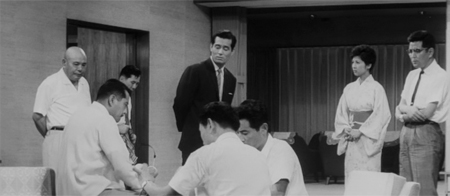
Almost the entire first hour of High and Low takes place in one room, but there is no lack of activity despite this fact. Just synchronizing the blocking must have taken a ton of work. The room is spacious because it belongs to Gondo, a wealthy industrialist [played by Toshiro Mifune] who is making a bid to take over his shoe company. Right after kicking out the other executive and just as he is about to send his assistant off to Osaka with 50 million dollars to complete the takeover, he gets a call from a man who has kidnapped his child and demands a $30 million ransom. Well it turns out it isn’t his kid that was kidnapped, but the chauffeur’s. The kidnapper demands the $30 million anyway. No police, unmarked bills, the usual deal. The police show up in a shoe delivery van, dressed as shoe delivery men and get to work. So we’ve got a standard police procedural, but we’re also dealing with Kurosawa.
The rub comes with the money. If Gondo doesn’t pay the ransom, the kid gets killed. If he does pay the ransom, he’ll be unable to takeover the company, and will be unable to repay all of the money he has borrowed in order to do so. There are several tense scenes where various parties struggle to rationalize this conundrum, but it really isn’t ever in doubt that he’ll fork over the cash. Not to do so would be dishonorable. Anyway, the whole friggin’ police force seems to get in on the investigation, mainly because of Gondo’s altruism. We’re talking around 100 cops working on this one case. Somehow I don’t think that would ever happen in the USA, but though this film was meant for a contemporary Japan, there are strong echoes of the clan loyalty we see in many samurai films. These echoes are deliberate and help highlight the social critique that is actually at the heart of the film.
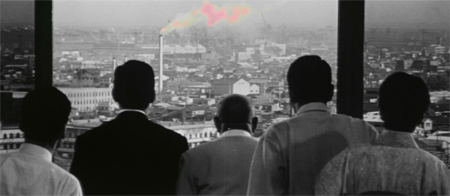
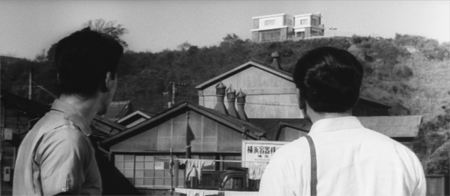
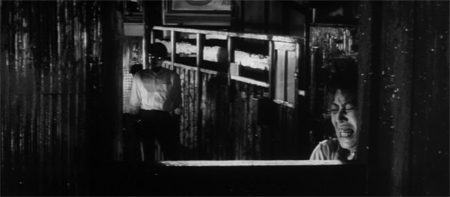
The kidnapper lives in the slum below the cliff estate of Gondo and comes to hate the man for his affluence. This is his motive. Even the cops, as they track the movements of the criminal, note that the estate looms over the town in a patronizing fashion. The fact that Gondo worked hard to make it where he was is of no consequence. The struggle is emblematic of the adolescent-stage transition of Japan to a more Westernized economy and culture. The kidnapper is not to be considered sympathetic, but it is certainly possible to empathize with his uncomprehending hatred of newly emerging class boundaries with Gondo as its symbol. Even in the latter third of the film, which contains an extremely marked change in style, substance and acting, the kidnapper hides behind mirrored glasses when he enters into the bustling, and very Western nightlife in search of some heroin. While Gondo can adapt, and continues to do so no matter how bad things get, the kidnapper can only react negatively to his environment Thus, at the end, when he says he does not fear death, he speaks the truth. Death would be welcomed by him. His ensuing breakdown I attribute to an inability to cope with the new face of Japan.
- Criterion Essay by Chuck Stephens
- MRQE Review List
- Senses of Cinema Review
- MovieMartyr Review
- Movie Stills
- Criterion Contraption Review
- YouTube clip