A part of this viewing list: Criterion Collection Spine #36: Henri-Georges Clouzot’s The Wages of Fear.
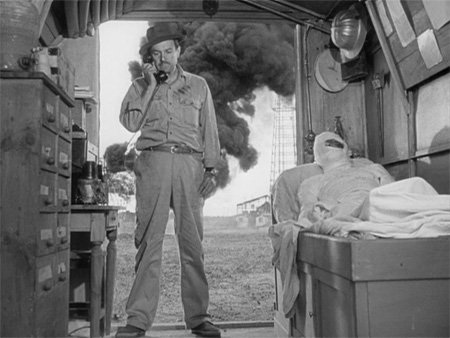
I no longer have any Criterion Collection films queued up at the library. After the inundation I’ve had with them over the last few weeks, I think it is time to take a bit of a break. Thankfully, the last film before this sabbatical was another suspenseful masterpiece by Henri-Georges Clouzot. The film is a hodge-podge of languages, French, English, Italian, Spanish and the odd German now and then; the polyglot atmosphere is one to be expected in a place where risky business pulls risk takers in for a chance to make a fortune. Like any boom town, Las Piedras has more bums than boomers, petty men too poor to leave, desperate for any chance that will enable them to do so. The first hour of the film is a necessary exposition of this desperation, in addition to important personality quirks and relationship establishment that will amplify in the more suspenseful nitroglycerin transport scenes. We learn about the vaguely homoerotic love triangle between Mario and Luigi [No, I am not kidding] that is broken up by the appearance of Jo. Mario’s disdain for Linda [once again played by the knockout Vera Clouzot, in more see-through clothing] is probably the greatest sign of his loss of perspective based on indolent disgruntlement.
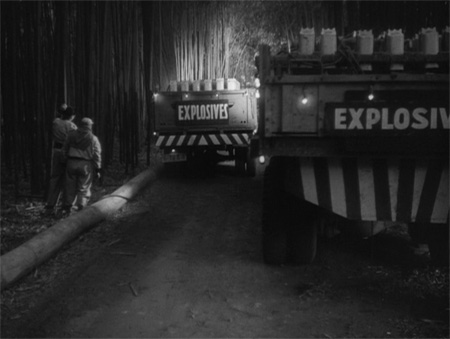
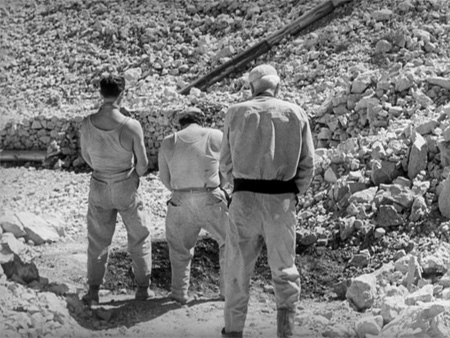
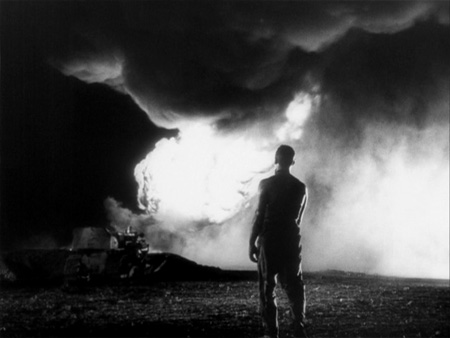
That the men are stuck in this predicament is based mainly upon their lack of citizenship in an unnamed South American country. The bullying, morally bankrupt presence of an American oil company doesn’t help matters, and there are multiple quotes that illustrate just what Clouzot thinks about this sort of corporate shenanigan. Where there is oil, Americans are quick to follow. Living in the hell that is Las Piedras, the four aforementioned men plus a German guy named Bimba make a deal with the devil [the Southern Oil Company] to drive two trucks full of hellfire [nitroglycerin] across hell to put out a fire. If they make it, they’ll get enough dough to leave Las Piedras far behind. The only problem is the slightest bump will explode the nitro. Obstacles include a 40 mile dash across something called “the washboard”; a hairpin turn involving a rotten bridge, blowing up a huge boulder in the middle of the road [and then pissing on the spot where it used to be], and driving through a 3′ deep lake of petroleum, which is all that is left of one of the trucks after it explodes. Like all deals with the devil, no one makes it out alive, no matter how safe they might seem. Especially once the distortion of constant fear sets in and you start to feel safe in thumbing your nose [or John Thomas] at the devil.
The wages of fear turn love to hate, uncover cowardice and pretty much ruin everything they can. As one man quotes earlier in the film:
You don’t know what fear is. But you’ll see. It’s catching. It’s catching like smallpox. And once you get it, it’s for life.
Most of the money quotes are in Dennis Lehane’s essay, which says pretty much everything that one needs to say about this film. What struck me about it was how its implicit and explicit cultural critiques are just as applicable fifty years after the film was made, especially in regard to immigrant labor issues and American corporate policy [and, by proxy, American policy as a whole] in regard to oil. And from an existential standpoint, the film is just as absurd and Camusian as Terry Gilliam’s Time Bandits. Clouzot knows we’re all doomed, and the only way to deal with the irony of risking death for a uncertain future is to laugh all the way to the grave.
- Criterion Essay by Dennis Lehane
- Culture Vulture review
- Roger Ebert Review
- Reelviews review
- Deep Focus review
- Criterion Contraption review
- Senses of Cinema on Clouzot
- YouTube: Trailer